
Yes, Bandcamp banned AI-generated music — and here’s what it means
The short answer to the ban on AI-generated music on Bandcamp
Did Bandcamp ban AI-generated music? Yes. In January 2026, Bandcamp announced a ban on uploading all music fully generated by AI, becoming one of the first major music platforms to take a hard stand against synthetic content. The policy is simple: music and audio created fully or partially with AI are prohibited on the platform. Any use of AI tools to imitate other artists or styles is also strictly prohibited.
The announcement was made both through a blog post titled “Keeping Bandcamp Human,” and via a Reddit post addressed to the platform’s community. Bandcamp reserves the right to remove any music if there is suspicion that it was created with AI, and users can report suspicious content through the platform’s reporting tools.
This is not a soft rule or a labeling requirement. It is a ban. If your track was created by entering a prompt into Suno, Udio, or any similar tool and uploading the raw output, Bandcamp does not want it on its platform.
Why this policy matters so much for the music industry
Imagine you’re an independent artist who spent months writing, recording, and mixing an album. You upload it to Bandcamp, and you have to compete for attention with thousands of tracks generated by someone in seconds using a text prompt. This is exactly the scenario this policy aims to prevent.
Bandcamp’s decision is important because it reflects a philosophical stance, not just a content moderation tweak. While platforms like Spotify still host AI-generated tracks that rack up millions of streams on viral charts, Bandcamp has chosen to prioritize human creators over algorithmic output. As noted by The Hollywood Reporter, this clearly defines the boundaries of the platform’s values.
We want musicians to keep making music, and fans to be confident that every song they find on Bandcamp was made by real people.
Timing matters. Deezer estimates that around 50,000 AI-generated songs are uploaded to streaming platforms daily. Artists like Sienna Rose and Breaking Rust have landed on Spotify’s Viral 50 chart. The flood is real, and Bandcamp has decided to build a wall rather than regulate the water level.
But here’s where it gets complicated. The policy bans music created “fully or significantly” with AI, leaving a gray area wide enough to drive a tour bus through. What counts as “significant”? Where does AI-assisted production end and AI-generated music begin? These are the questions this article addresses, along with how enforcement actually works, what other platforms are doing differently, and what working musicians should do right now to stay compliant.
Why Bandcamp took a stand against AI-generated music
Bandcamp’s artist-first philosophy is at the heart of the ban
Bandcamp’s ban on AI-generated music is not an impulsive reaction to a trendy news headline. It is a logical extension of the platform’s very essence. Since its inception, Bandcamp has operated on a simple principle: directly connecting artists with fans, allowing fans to pay them fairly, and staying out of their relationship. However, this approach only works if the artists on the platform are genuinely real musicians.
In an official blog post, the solution is presented in almost philosophical terms: music here is understood not merely as a commodity for consumption, but as something deeper.
Music is not just a commodity for consumption. It is the result of a cultural dialogue between people, which originated long before the advent of writing.
These formulations fully reveal the project's motivation. Bandcamp sees itself not just as a music store, but as a cultural institution. When the market becomes flooded with tracks created using AI, they compete not only with musicians for sales—they undermine the entire music ecosystem. Fans browsing a specific genre page cannot immediately tell whether the author spent six months creating the track or just six seconds generating it. This uncertainty undermines trust—and trust is precisely the currency on which Bandcamp's business model is built.
Songtradr's acquisition of the company at the end of 2023 raised questions about whether Bandcamp would stray from its indie roots. However, the new management has only strengthened its commitment to these principles. By announcing a clear policy regarding generative AI, Bandcamp emphasized that its identity as a human-centric platform is not just brand heritage, but an active strategy. The blog post explicitly states that musicians are “important members of our communities, our culture, and our social fabric,” rather than just producers of sound. Such wording makes the ban appear less like a content moderation rule and more like a clearly articulated and consistently implemented mission.
Industry pressures that accelerated the decision
Bandcamp did not take this step in a vacuum. The broader music industry was already experiencing a gradually escalating crisis caused by AI-generated content, and several major events created the necessary momentum for taking a decisive stance.
Consider the legal landscape. Major record labels have sued Suno and Udio—two of the most popular AI-based music generators—for copyright infringement, claiming that these tools were trained on copyrighted recordings without proper permission. These lawsuits served as a serious warning to the entire AI music ecosystem. Warner Music Group publicly expressed its disagreement with using artists' music catalogs to train AI without licensing. The position of the industry's biggest players was clear: music generated by AI based on human creativity without proper consent is unacceptable.
Then there is the issue of discoverability—the ability of users to find new music. When tens of thousands of AI-using tracks are uploaded to streaming platforms daily, independent artists simply fade into the content stream. The conflict between Bandcamp and AI-generated music was inevitable: the platform's very value is based on fans being able to find real people creating authentic art. If the catalog becomes overloaded with low-quality AI-generated compositions, the platform will lose what makes it unique. An independent producer releasing their debut EP should not have to compete with someone who created 500 albums over a weekend using text prompts.
These pressures converged at the perfect moment. Copyright lawsuits gave legal validity to these concerns. The abundance of AI-based content on competing platforms clearly demonstrated the real threat. Meanwhile, Bandcamp's own community had already identified suspicious uploads and demanded clarity. The ban was aimed not only at protecting musicians but also at preserving the platform's identity before this wave became uncontrollable.
Nevertheless, announcing a new policy is one thing, while clearly defining exactly what it covers, especially in the ambiguous zone between content “exclusively generated by AI” and materials created “with AI assistance,” is quite another.
A complete analysis of Bandcamp's AI music policy.
To understand what Bandcamp's AI music policy actually states, you don't necessarily need to read the blog post, Reddit discussions, user agreement updates, or dozens of community comments. Yet this is precisely the situation most musicians face. Below is a summary of all the necessary information in one place for quick reference.
What the Official Bandcamp Policy Statement Says
The policy, published on January 13, 2026 under the title “Keeping Bandcamp Human,” establishes two main rules:
- Music and audio created entirely or substantially with the help of AI are not allowed on Bandcamp.
- Any use of AI tools to imitate other artists or styles is strictly prohibited in accordance with existing rules against impersonation and intellectual property rights violations.
The phrase “in whole or in substantial part” plays a key role here. This means that the ban applies not only to tracks created entirely by machines. If generative AI generated the majority of a composition, arrangement, or performance, such a track is considered a policy violation—regardless of whether a person made minor edits afterward.
Bandcamp has also updated its acceptable use and moderation policy, introducing a ban on scraping, text and data mining, as well as any use of its catalog for training machine learning or artificial intelligence models. As Side-Line commented on the situation, this results in Company creating a strict isolated environment: no generative outputs coming in, and no training data going out.
Penalties and Consequences of Violating the Ban
What happens if you still upload AI-generated music? The consequences will be significant, and Bandcamp has granted itself broad authority in how to respond. Here is what violators will face:
- Content Removal: Bandcamp reserves the right to remove any music if there is suspicion that it was created using AI. Note the word “suspicion”—irrefutable proof or technical verification is not required for removal.
- Account Removal: Multiple violations or egregious cases may lead to complete account removal. Some creators have already reported that their catalogs were completely removed without prior warning.
- Income Consequences: When an account is removed, all pending payouts and sales history disappear. Bandcamp has not published an official income refund policy, but account removal effectively terminates all future and potentially expected payouts.
One point that left many sellers completely baffled is the criterion for taking action: it is based not on factual evidence, but on subjective perception. Bandcamp explicitly states that it may take action based solely on suspicion. This approach imposes lower requirements compared to the standards of most other platforms and provides the moderation team with significant discretion.
How This Policy Applies to Previously Uploaded Materials
You may be wondering what happened to AI-created tracks that were already on the platform before January 2026. Bandcamp's policy regarding AI-generated music was essentially unregulated by 2025—there were no explicit rules against AI-generated content, and some creators openly labeled their releases with tags such as “AI-generated music” or “AI-made music.”
When the ban came into effect, it was applied retroactively. Existing AI-generated content became subject to the same removal standards as new uploads. Community members reported old releases, and the Bandcamp team began reviewing and removing them. One affected creator, Fuzzy Cracklins, described their experience in comments on the blog:
Could you at least have warned us in advance before starting to delete our accounts? I was sure that my music files were securely stored on this platform, but in the end, I found that they had disappeared forever.
This retrospective approach means that Bandcamp's policy on AI-generated music, effective in 2026, is not only prospective. If you uploaded AI-generated content in 2024 or 2025, and it is still available, it is now considered a violation. No “grandfather clause,” no publicly announced transition period, and no official prior notice for sellers affected by content removal measures were provided.
For artists who use artificial intelligence tools not as a replacement for the entire creative process, but as part of it, the key question is: where exactly does the “substantial part” of the work begin? It is in this distinction between AI-assisted works and fully AI-generated works that the main confusion arises.
Comparison of AI-Assisted Music vs. Fully AI-Generated Music: A Detailed Explanation
Does Bandcamp allow AI-generated music at all? The answer is not straightforward. The ban applies to music created fully or partially by AI, but it does not prohibit all tools that include the word “AI” in their marketing copy. The distinction comes down to one question: who made the creative decisions—human or machine?
Think of it this way: a carpenter using a drill is still building a table. But if a robot assembles the entire table from a blueprint while the carpenter watches, that’s a different story. Bandcamp announced a new policy banning exclusively AI-generated music, not any software that uses machine learning.
AI Tools Still Allowed on Bandcamp
AI-assisted music, as RouteNote explains, is music created by a human artist who uses AI as a tool to support or enhance their creative process. The artist retains control. AI is a co-pilot, not the creator. You guide the process, make decisions, and shape the final product.
A prime example: The Beatles’ song “Now and Then” used AI-powered audio restoration to isolate John Lennon’s vocals from old demo tapes. The track won a Grammy Award. No one questioned its authenticity because the AI performed a specific technical function within a deeply human creative project.
Here is a practical comparison of what falls on either side of the line for AI-assisted music on Bandcamp:
| Workflow | Example Tools | Current Status on Bandcamp | Why |
|---|---|---|---|
| AI Mastering | LANDR, iZotope Ozone AI | Allowed | Human creates the music; AI optimizes the final mix. |
| AI Stem Separation | iZotope Neutron, Sonible smart: EQ | Allowed | AI system suggests settings; human approves and adjusts them. |
| AI Stem Separation | Lalal.ai, iZotope RX | Allowed | Technical processing tool, not a creative generation tool. |
| AI-suggested chord progressions used as a starting sketch | Scaler, Captain Chords | Allowed (with conditions) | Human substantially reworks the material and creates the final composition. |
| AI Noise Reduction and Audio Restoration | iZotope RX, Adobe Podcast | Allowed | Enhances existing human-created recordings. |
| Text-to-music generation uploaded as-is | Suno, Udio, MusicGen | Banned | AI is the creator; no significant human creative input. |
| Full AI-generated tracks with minor manual edits | Suno output with added reverb or EQ | Banned | Minor parameter tweaks do not constitute significant human authorship. |
| AI Voice Cloning to mimic artists | Various deepfake tools | Banned | Violates both AI policy and impersonation rules. |
| Automatically generated instrumental tracks without human performance | Any generative model | Banned | Composition and arrangement are machine-produced. |
The pattern is clear: if AI performs a discrete technical task within a human-driven project, it’s fine. But if AI takes over the creative heavy lifting—writing melodies, structuring songs, arranging, or writing lyrics—it violates the rules.
Where the lines between creators become blurred
The real confusion lies in the middle. Let's consider scenarios that Bandcamp's policy does not explicitly address:
You write lyrics, record your vocals, and layer them over an instrumental track generated by AI. Can this be considered a "substantial part" of AI? The composition was created by a machine, but the vocal performance and lyrical content are entirely human. Reasonable people disagree on which category this falls into.
Or imagine you use an AI tool to generate a melody, then reharmonize it, change the rhythm, rearrange the structure, re-record it with live instruments, and add your own bridge and outro. The seed was AI, but the final product may be a new human creation. As The Conversation notes, even the Grammys face this same gray area—if AI generates a catchy hook and a human builds everything else around it, is the human contribution still "significant and important"?
Then there is the issue of electronic music. Producers in genres such as ambient, techno, and generative music have been using algorithmic and procedural composition methods for decades. Some of these workflows are functionally similar to AI generation from a technical standpoint, although they involve deep human involvement at every stage. Gearnews directly raised this question, noting that intelligent mastering tools, synthesis processes, and mixing algorithms have long been part of production reality.
The phrase "Music and audio data created fully or significantly using artificial intelligence" allows for various interpretations, causing uncertainty within the professional community.
The honest answer is: no one—including Bandcamp—has drawn a clear technical boundary. This policy is based on intent and degree of involvement, not on a rigid list of criteria. If you use AI as one ingredient in your creative process—you are probably safe. But if the dish is entirely cooked by AI and you just served it on a plate—in that case, you will not be considered eligible.
For producers working in the uncertain gray zone, the most reliable approach is thorough documentation. Keep project files, record session histories, and be prepared to prove that key creative decisions were made by humans. After all, despite the general wording of the policy, its application depends on how much your work looks and sounds like it was created by a human who has something to say—and this subjective judgment can be viewed either positively or negatively.
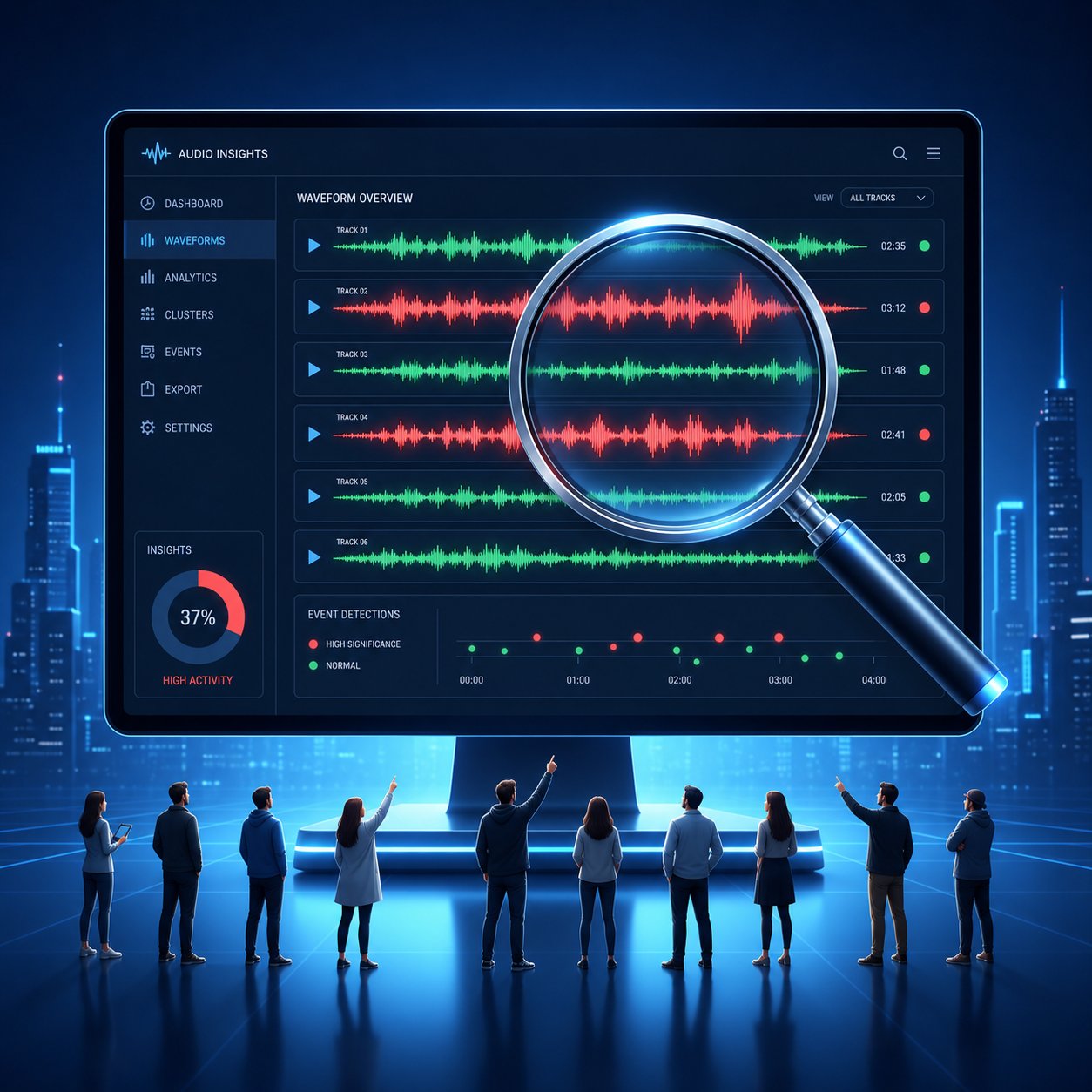
How Bandcamp enforces the ban on AI-generated music
The strength of a policy is determined solely by the effectiveness of its enforcement. Bandcamp has clearly banned AI-generated music, yet the platform remains extremely opaque about how it practically detects synthetic content. It is this gap between stated policy and actual implementation that causes the most concern among most musicians. So what do we actually know about how this compliance system works?
How Bandcamp detects AI-generated content uploads
Here is the honest truth: Bandcamp has not publicly provided detailed information about its technical detection system. Unlike Deezer, which launched a special AI-based detection tool capable of flagging tens of thousands of tracks daily, Bandcamp has not announced any similar automated scanner. From the official blog post, we know only the minimum: flag suspicious content, and the team will review it.
Nevertheless, several detection methods are technically available and likely play some role in this process.
- Metadata Analysis: AI generators, such as Suno and Udio, embed identifiable metadata into exported files. Checking for these signatures requires little effort and is highly reliable if they are present.
- Spectral Artifact Analysis: research published at ISMIR 2025 demonstrated that AI generators leave microscopic "fingerprints" in the frequency domain. These architecture-dependent spectral peaks exist independently of training data, and detection models achieved over 99% accuracy, identifying them in outputs from Suno, Udio, and open-source generators.
- Temporal Quantization Detection: musicians introduce micro-rhythmic variations even in electronic music. AI generators tend to lock transients to a mathematically perfect grid. When the variance of intervals between beats approaches zero, the likelihood of synthetic generation increases significantly.
- Account Behavior Models: an account uploading 50 albums in a week raises obvious suspicions. The volume and speed of uploads can trigger manual review even without audio analysis.
It is not yet confirmed whether Bandcamp uses all, some, or none of these methods in its internal system. It appears that the platform relies heavily on human assessment rather than automated mass content scanning.
Limitations of Modern AI-Based Music Content Detection Systems
Even the most advanced recognition technologies have "blind spots," and artists should understand these limitations. A survey cited by Reuters showed that 97% of listeners were unable to distinguish songs generated by artificial intelligence from recordings made by humans. If experienced ears struggle, automated systems face their own challenges.
Research conducted as part of the ISMIR conference revealed a number of serious shortcomings in modern detection methods.
- Simple resampling of audio data to a frequency of 22.05 kHz caused one commercial detector to mistakenly classify all Suno samples and most Udio samples.
- Detectors trained on one platform often do not work properly on others. Models trained on Suno performed well when tested with Udio, but when tested with Boomy, their effectiveness dropped to 6–24% in terms of detection rate.
- Post-processing AI output using a standard DAW, applying effects, or re-recording using analog equipment can fool detectors that recognize signs of signal processing stages in production rather than genuine characteristics inherent to AI.
This means that a determined attacker is unlikely to be detected. It is enough to pass an AI-generated audio track through analog processing, resample it, and add a few live elements, and most automated systems will be at a loss. Bandcamp's reliance on the "suspicion" criterion as a basis for removal partially addresses this issue, but simultaneously creates a risk of false positives, which causes concern among legitimate artists.
Community Feedback and Manual Review
The control mechanism that Bandcamp emphasizes is based on community participation. In a blog post, users are explicitly encouraged: "If you encounter music or audio that appears to have been created entirely or largely using generative AI, please use our reporting tools to flag the content for review by our team."
This approach, based on collective participation, has both strengths and vulnerabilities. On the positive side, the Bandcamp community is deeply invested in the platform's identity. Fans and fellow artists who care about human-created music are motivated to report suspicious content. They notice what algorithms might miss—for example, an artist's lack of social media presence, lack of live performance history, and an incredibly frequent release schedule. As reported by BBC News, it was these behavioral signals that internet detectives used to identify suspicious AI-related activities, such as The Velvet Sundown, on other platforms.
The vulnerability of this system is equally obvious: the user community reporting system can be weaponized. As one commenter on the Bandcamp blog noted: once "suspicion alone is enough," anyone can be harmed. An artist whose works sound too perfectly polished, whose creative activity is too predictable, or who simply has enemies, may become a target of malicious complaints. Electronic musicians working in genres such as minimalism or algorithmic music are particularly vulnerable: their works may seem similar at first glance to AI-generated results, even if every musical decision was made consciously by a human.
Bandcamp prohibits music created using artificial intelligence, yet the platform exercises broad discretion in its decision-making. It does not publish details on how disputes are resolved, what evidence an accused artist may present in their defense, or how long the review process takes. This ambiguity currently remains the primary unresolved issue in the enforcement of these rules. Artists acting in good faith are forced to hope that their music is “human-like enough” to pass scrutiny—a criterion perceived as overly subjective.
As detection technologies evolve and standards such as C2PA metadata and Google’s SynthID watermarks become widespread, oversight is likely to become more precise. The EU’s transparency requirements under the AI Act, effective from August 2026, will require AI providers to embed machine-readable watermarks in generated content. This regulatory support may ultimately provide platforms like Bandcamp with a reliable technical signal for enforcement. Until then, oversight remains a patchwork of community vigilance, manual review, and educated guesses.
The picture of enforcement is incomplete, but the existence of this policy still changes behavior. Knowing that Bandcamp has announced a ban on uploading all AI-generated music—even if this ban is not always enforced—changes the calculations for anyone considering flooding the platform with synthetic content. For most artists, the main question is not whether they will be caught. The question is how the broader ecosystem of platforms handles AI-generated music differently, and what this means for where they distribute their work.
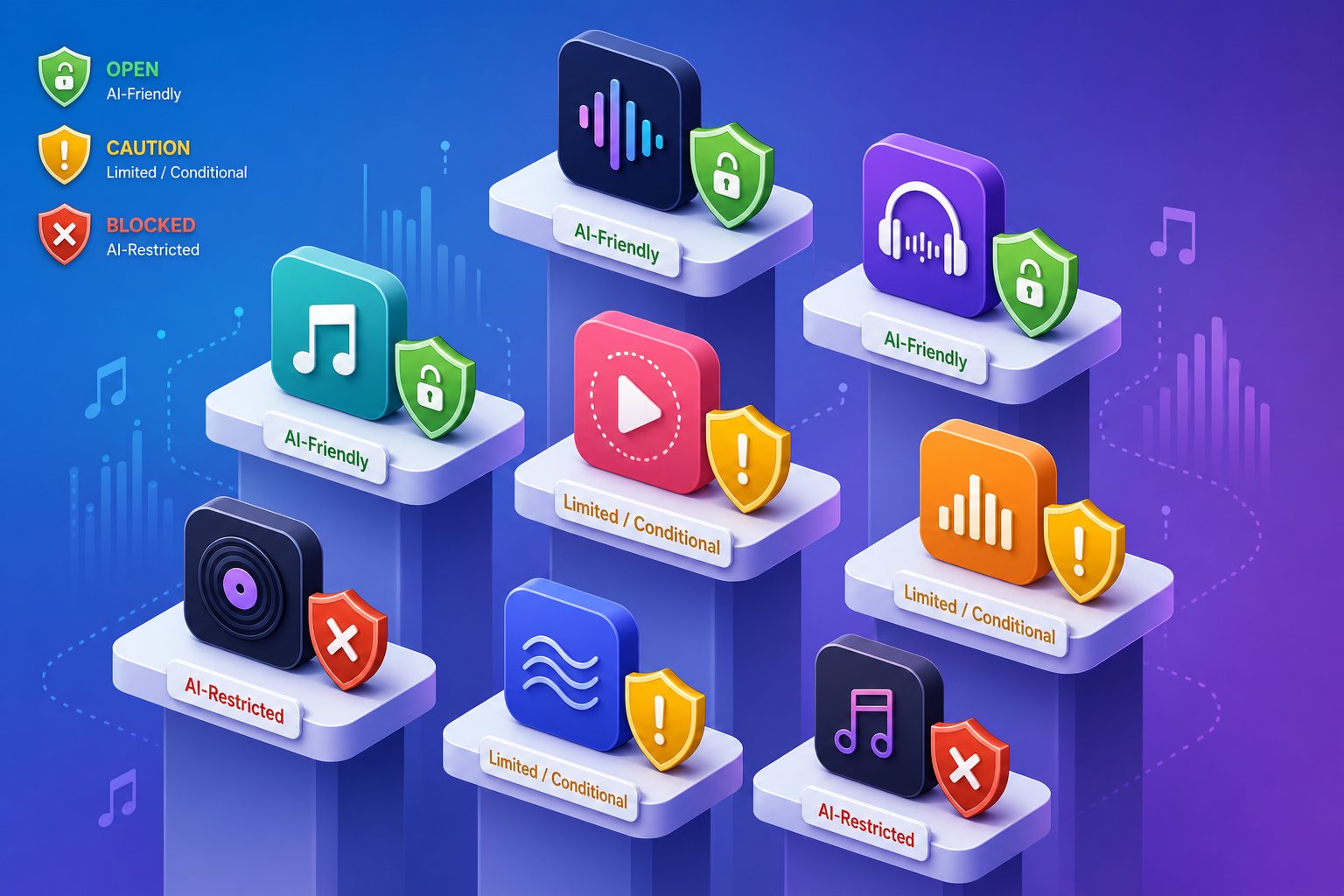
Comparison of Music Content Policies Across Major Music Platforms
Ban on AI-generated music on Bandcamp represents the most decisive stance among all major music platforms. However, it is not the only approach: each streaming service and music distributor has been forced to define its own rules, resulting in a heterogeneous landscape—a mix of bans, labeling requirements, silent tolerance, and constantly shifting gray areas. If you distribute music across multiple platforms, understanding these differences is not just desirable but essential: it determines where your music can be published and how it will be treated.
How Major Music Platforms Differently Approach the Use of AI-Generated Music
The spectrum ranges from complete prohibition to open acceptance. On one end, Bandcamp entirely rejects content created using AI. On the other, platforms like SoundCloud operate with virtually no AI-related restrictions. Most services fall somewhere in between, requiring disclosure but not banning the content itself.
Here is how the comparison of key players looks:
| Platform | AI Policy in the Music Industry | Labeling / Disclosure | Monetization | Enforcement Approach |
|---|---|---|---|---|
| Bandcamp | Prohibited — music fully or significantly generated using artificial intelligence is not allowed. | Not applicable (content is not permitted) | Not applicable | Community reporting, manual review, removal upon suspicion |
| Spotify | Permitted with public disclosure; unauthorized use of AI-based voice clones is prohibited. | Required according to distributor metadata in DDEX format. | Same per-stream rates as for human-made music. | Spam filter for mass content; removal of content created using voice cloning technology. |
| Apple Music | Adopts a transparency-oriented approach. | Labels and distributors are required to provide additional metadata indicating the use of AI technologies. | Standard royalty rates | Operates based on distributor compliance with established rules; no automatic detection system for the general public. |
| YouTube Music | Permitted under certain conditions; raw audio recordings created with minimal human intervention are considered low-value data. | Mandatory disclosure of AI use; “transformative human contribution” is expected. | Content generated using AI and not leading to commercialization may be demonetized or removed. | Content ID system; manual review of content flagged for attention |
| SoundCloud | No specific restrictions; one of the most open among major platforms. | No formal requirements for disclosing AI systems. | Standard monetization via SoundCloud Premier | Standard content policies; company commits not to use user-uploaded data for training AI systems without explicit consent. |
| Amazon Music | No detailed public policy; focus is on ensuring “catalog integrity.” | No provisions for explicit disclosure. | Standard rates; Suno integration into Alexa Plus | Quiet removal of content flagged as copyright-infringing; collaboration with music labels to combat voice cloning. |
| Deezer | Permitted, but with mandatory labeling and lower priority. | Specialized AI detection tool automatically labels tracks created using artificial intelligence. | Users excluded from algorithmic and editorial recommendations, and fake streams excluded from royalty calculations, do not participate in AI algorithm analysis. | Automated large-scale detection and annotation |
| DistroKid | Accepts musical compositions created using AI for distribution across all platforms. | Mandatory disclosure during upload | Standard pricing model; unlimited uploads. | Operates by enforcing rules on downstream platforms. |
Note the pattern. Most platforms do not question whether AI-generated music should exist. They ask how it should be labeled, tracked, and displayed. Bandcamp is the exception, completely rejecting this premise.
Labeling Requirements vs. Full Ban
The fundamental philosophical divide in the industry boils down to two camps: transparency versus prohibition.
Spotify, Apple Music, and YouTube Music represent the transparency camp. Their logic is pragmatic—AI-generated music will appear anyway, so the priority is to ensure that listeners and rights holders know what they are hearing. New Apple metadata requirements mandate that labels and distributors disclose AI involvement in everything from the music itself to the cover art. Spotify has adopted the DDEX standard, so AI-generated tracks have proper authorship data in their backend systems. YouTube requires “transformative human participation” and penalizes content that does not meet this criterion by disabling monetization rather than removing it.
Ban on AI-generated music on the Bandcamp platform is among the strict prohibitive measures—alongside the more balanced approach of the Deezer service. Deezer does not completely block AI-generated content; however, its own intelligent tool for detecting such content identifies and labels songs fully generated by AI, after which it excludes them from recommendations and does not count their streams when calculating royalty payments. The effect is similar to a full ban: AI-generated tracks remain available on the platform but cannot generate revenue and receive no visibility through either editorial playlists or algorithmic recommendations.
For musicians, the practical difference turns out to be quite significant. On Spotify, you can release AI-assisted music, properly register it through a distributor, and earn the same revenue per stream as any other composition. On Bandcamp, the same composition could lead to its removal from the platform if the AI contribution exceeds the “substantial part” threshold. On Deezer, a track may remain available but never reach a single listener through recommendations.
SoundCloud occupies a completely unique niche in the market. Thanks to the absence of mandatory AI-related disclosure requirements and the ability to upload content directly—which allows bypassing distributor controls—the platform has become what it is today. Some community members call it a “Haven for AI-generated music.” The primary goal of this platform is to protect existing creators from having their uploaded content used as training data for artificial intelligence systems, rather than restricting the process of publishing new content itself.
Amazon Music likely holds the most controversial position of all. The company has not published a detailed AI policy and has quietly removed content raising intellectual property concerns. At the same time, it has integrated the Suno service directly into Alexa Plus, allowing users to create songs on demand within a single ecosystem. The contradiction between providing AI-based content generation tools and maintaining the integrity of the music catalog remains unresolved.
What does all this mean for professional musicians? If you distribute your music across multiple platforms, your compliance obligations vary significantly depending on the platform where your material appears. A track that is considered fully acceptable on Spotify with proper attribution may completely violate Bandcamp’s policy. Meanwhile, a composition that Deezer’s detection system classifies as AI-generated may pass moderation on SoundCloud without issue and raise no doubts.
The digital content sphere is highly fragmented: rule definitions are ambiguous, and enforcement mechanisms range from complex automated violation detection systems to formulas like “we will review your case if someone files a complaint against you.” For musicians and artists operating in this heterogeneous environment, the safest strategy is to understand not only what each platform prohibits but also what it values, and to choose distribution channels for their materials accordingly.
This awareness of cross-platform nuances is especially important for those who work with music every day. Differences in policy are not merely theoretical—they directly influence real-world decisions regarding workflows, disclosure, and where to direct one’s creative efforts.
What Professional Musicians Need to Know and Do
Technical details of policies and platform comparisons are useful as context, but they do not answer the main question that most musicians actually ask: what exactly needs to change in my way of working? Whether you are a solo producer creating music at home using plugins exclusively, an electronic musician whose genre lies in a gray area, or a band that occasionally uses AI tools for preliminary musical sketches—Bandcamp’s updated 2025 and 2026 policy on AI-generated music requires a practical response.
The good news is that if you are a person creating music with conscious intent, you are likely safe. The key now is to prove it.
How to Audit Your Music Production Workflow
Think of this as a creative supply chain audit: you need to trace every element of your process back to a specific human decision. It doesn’t mean all your tools have to be analog or AI-free — the point is to ensure that artificial intelligence serves you, not the other way around.
Here is a step-by-step checklist to review your workflow before uploading content to Bandcamp.
- List all AI-powered tools in your signal chain. This includes mastering services like LANDR, intelligent EQ plugins, AI stem splitters, chord suggestion tools, and any generative features within your DAW. Don’t forget the less obvious ones — some sample libraries now use AI to generate variations.
- Define the role of each tool. For each AI tool on your list, ask yourself: Did it make creative decisions, or did it perform technical tasks under my direction? An intelligent EQ adjusting frequency balance is a technical task. An AI generating a four-bar melody that you left unchanged is a creative task.
- Identify any generative content in your final mix. Did any AI tool create audio, MIDI, lyrics, or arrangements that ended up in the released version without substantial human reworking? If so, that element represents a potential compliance risk.
- Assess the proportion. Bandcamp’s threshold is “wholly or predominantly.” If AI-generated elements make up the backing track in one section of a ten-track album, that’s different from AI generating the entire harmonic and melodic foundation of every song. Proportions matter.
- Document your human contribution. Keep DAW session files, version histories, rough recordings, handwritten notes, and demos. This creates a paper trail of iterative human decision-making throughout the production process.
- Retain your original prompts and generation logs. If you used any generative tool during production — even as a brainstorming aid that you later discarded — keep records of what was generated and what you actually used. As industry safety checklists recommend, keeping original prompts serves as proof of creative work in disputes.
- Conduct a final honesty check. Could a reasonable person listen to your track, review the session files, and conclude that significant creative decisions were made by a human? If yes, upload with confidence.
For each new release, this process might take about thirty minutes. It’s not overly burdensome, but it does require mindfulness — especially for producers who have integrated AI tools so deeply into their workflow that the line between human and AI has become nearly indistinguishable.
What Independent Artists Should Do Right Now
Different types of creators face varying levels of risk under this policy. Here’s a detailed breakdown of those differences:
Hobbyist producers using AI plugins for mixing and mastering have the least to worry about. Your creative process — writing, performing, arranging — is human. The AI tools you rely on are production aids, not content generators. Keep working as usual, but save your session files as a precaution.
Electronic musicians and ambient artists face the most uncertainty. Generative synthesis, algorithmic composition, and procedural methods have been part of electronic music for decades. If your workflow involves Max/MSP patches, modular synth randomization, or generative sequencing, you’re using “AI” in a sense different from what Bandcamp means — but your output may sound indistinguishable from AI-generated content to a reviewer unfamiliar with your genre. Document your process thoroughly. A short video of your live patching session or a screenshot of your modular setup carries more weight than any written explanation.
Bands and singer-songwriters who occasionally use AI for inspiration — such as generating chord progressions to overcome writer’s block, or using AI to sketch arrangements that are then re-recorded live — are generally safe, provided the final recording reflects human performance and creative judgment. The seeding matters less than the harvest.
Artists concerned about false positives should take proactive steps. Since Bandcamp announced the ban on uploading all AI-generated music, enforcing measures based on suspicion and community reports, anyone can become a target. Human-verified strategies are becoming necessary—not because you did something wrong, but because the burden of proof may unexpectedly shift to you. Consider the following protective measures:
- Maintain an active creative presence in public spaces: social media posts with work-in-progress materials, studio session recordings, or live performances will help audiences perceive your work as authentic, human creativity.
- Preserve metadata intact when exporting. Do not remove ID3 tags and session data that can help verify your software and workflow.
- If you publish content very frequently, be sure to space out your uploads. An account that releases dozens of albums in succession triggers the same suspicious reactions as actual spam activity generated by AI—even if every track was recorded manually.
- Actively engage with the Bandcamp community. Artists with loyal fans, active comments, and purchase histories are fundamentally different from anonymous accounts that simply upload content without any audience interaction.
How the ban affects search engine discoverability for professional musicians
For artists who support this policy, the practical benefit is clear: the less noise in the catalog, the clearer their creative signal becomes.
Prior to the ban, genre pages and search results on Bandcamp were increasingly filled with AI-generated content. Some authors uploaded hundreds of albums created from text prompts, leading to overloaded niche tags and making it difficult for fans to find genuine artists. Bandcamp’s 2026 AI-generated music policy directly addresses this issue by completely removing such content from the platform’s ecosystem.
Improved discoverability works on several levels. Reducing the total number of releases in any genre category means that each human-created album occupies a larger share of the browsing space. Fans who previously stopped exploring new genres due to diluted content quality may return to discovery. Additionally, Bandcamp’s editorial team—which runs the Bandcamp Daily blog and curates thematic collections—will be able to focus entirely on supporting living artists, without needing to check every recommended release for AI involvement.
There is also what is known as a trust dividend. When fans understand that everything available on Bandcamp is created by humans, the platform itself becomes a signal of quality. Purchasing music on Bandcamp carries an implicit guarantee: this work was created by a real person—and for an increasingly broad audience actively seeking authentic human expression, such a guarantee has real value.
On the other hand, imperfections in enforcement mechanisms cause resistance. If legitimate artists find themselves in situations of false positives within the filtering system, or if the user community reporting system begins to be used as a tool for pressuring competitors, trust in the platform gradually erodes. The long-term success of this policy will depend on how well Bandcamp refines its verification system to effectively protect the artists it was originally designed to support.
All of this applies exclusively to the sale and distribution of music on the Bandcamp platform. However, many creators do not sell AI-generated music—they need it for their own projects. Video editors, podcast hosts, game developers, and social media content creators have entirely different needs, and this restriction does not impact their capabilities as severely as it might initially seem.
Where creators can still legally use AI-generated music
Here is a distinction often overlooked in headlines: Bandcamp announced a ban on uploading all AI-generated music to its marketplace. However, this does not mean that using AI-generated music is prohibited everywhere. This policy targets sellers—people uploading AI-generated tracks for sale or streaming on the Bandcamp platform. If you are a video producer needing background music for a YouTube documentary, a podcaster looking for an intro, or a game developer creating a soundtrack, Bandcamp’s policy will not affect your work at all.
The confusion is understandable. When people search for information on whether Bandcamp has banned AI-generated music, they often confuse two completely different use cases: distributing AI-generated music as a product and using AI-generated music as a tool for production. One option is prohibited on Bandcamp. The other remains fully legal and widespread in the creative industry.
So what options remain for content creators who truly need affordable, royalty-free music for commercial projects?
Solutions for creators who need AI-based music for their projects
You are working on editing a travel vlog at midnight—the video deadline is tomorrow. You need a two-minute background music track that matches the mood of the clip, won't trigger copyright claims, and is free. You don't plan to sell this track on any platform—you just need to use it in your video. This scenario plays out millions of times a day for creators across all media formats.
In fact, AI-generated music videos have never been the primary way most content creators use the Bandcamp platform. They weren't buying AI-generated tracks from sellers on Bandcamp—instead, they either created their own background music or used it from royalty-free libraries. These options remain fully available.
- Songai Free Music Generator — a free AI-powered music creation tool designed specifically for content creators who need free tracks for videos, podcasts, social media, and games. You can create music for your own commercial projects without licensing fees or attribution requirements, making it practical for creators on a tight budget who need quick turnaround.
- Soundraw — a subscription-based AI music creation platform popular among YouTubers and podcasters. Offers customization of genre, mood, and tempo with full commercial licensing for generated tracks.
- AIVA — specializes in orchestral and cinematic compositions. Offers both free and paid tiers, with commercial licensing available via subscription. Particularly useful for creating music for films and games.
- Mubert — generates adaptive, royalty-free music in real time. API integration makes it especially useful for app developers and streamers who need dynamic soundscapes.
- Artlist.io — a carefully curated library of human-created, royalty-free music with a simple universal license. Not AI-generated, but worth mentioning for content creators who prefer human-made tracks with a clear legal framework.
- Ecrett Music — AI-based music generation designed specifically for video creators. Select the content type—vlog, advertisement, documentary—and the tool will create suitable background music.
Each of these tools targets its specific niche. Some creators want full control over generation parameters, while others are satisfied simply getting sound that is high-quality and legally safe. The key point is that none of these tools require uploading or selling content on music platforms. You create, use, and can confidently move on.
Using AI-based music generators for content creation
The legal side of AI-generated music is complex when you distribute it as a product. But when you use it as an element in producing your own content, the situation becomes significantly simpler. As explained in Silverman Sound Studios' copyright analysis, the main legal risks associated with AI-generated music focus on ownership claims and copyright registration—issues that matter when selling music, not when creating a soundtrack for your own podcast.
Nevertheless, creators should still exercise basic due diligence.
- Check licensing terms. Free doesn't always mean unlimited use. Some AI generators provide commercial usage rights only within paid plans. Others restrict use to specific platforms or content types. Review the terms before publishing.
- Understand what "royalty-free" actually means. It means you pay once (or nothing) and use the music without ongoing royalty payments. It does not necessarily mean you own the copyright to the generated track. For production use, this distinction rarely matters, but it's worth knowing.
- Avoid prompts that reference specific artists. Generating a "track that sounds like Drake" or "in the style of Taylor Swift" creates copyright infringement risk regardless of how you use the result. Stick to prompts based on genre and mood, not on specific artists.
- Consider specific platform policies. YouTube's policy on AI-generated audio content is constantly evolving. Increasingly, you are expected to disclose AI involvement in your video description, even if the music is merely background.
For most content creators, AI-based music generators address an important practical need that human-curated music libraries cannot always meet—especially under budget constraints, tight deadlines, and when music serves a supporting role rather than being the main product. The key distinction is this: AI-generated music videos posted on Bandcamp (their sale is prohibited) versus AI-generated music used in your videos (which is fully legal for content creators)—this is the difference that matters most.
The ban introduced by Bandcamp protects live musicians from price pressure caused by synthetic content in their own market. It does not prevent you from using artificial intelligence tools to create musical soundtracks, promote your brand, or enhance creative projects. These are two fundamentally different areas of activity, and the sooner the discussion acknowledges this difference, the clearer the path forward will become for all stakeholders.