
DistroKid's Official Stance on AI-Generated Music
Does DistroKid accept music created with AI? Yes, it does. But this "yes" comes with conditions, and ignoring them can either contribute to your success or lead to the failure of your account. DistroKid allows music created using AI tools, provided that certain rules regarding copyright, disclosure, and content guidelines set by streaming platforms are followed.
The Short Answer to DistroKid's AI Policy
In DistroKid's official support documentation, this policy is clearly stated:
Yes — DistroKid accepts music created using artificial intelligence tools, but certain rules apply. All music files uploaded to DistroKid must comply with the content guidelines of streaming services, regardless of whether the music was created with AI or not.
All these rules boil down to four non-negotiable requirements:
- You must own 100% of the rights — including the legal right to distribute everything created using AI tools, samples, or lyrics.
- Impersonation is prohibited — your music cannot imitate or copy someone else's voice, appearance, or identity without permission.
- Mass spamming is prohibited — content created solely to manipulate streaming algorithms or flood platforms with generic content violates platform rules.
- Copyright infringement is prohibited — your release must not infringe on the rights of others.
You can now upload AI-generated music to the DistroKid platform. The platform will not reject a track simply because AI was used in its creation. Rejection or penalties against your account occur if you fail to comply with the above conditions or miss the mandatory disclosure when uploading material.
Why This Policy Is So Important for Independent Creators
Imagine spending hours creating a track using an AI-based composition tool, only to have it removed from Spotify two weeks after release with a vague notification about policy violations. This scenario is more common than you might think, and it is almost always linked to incomplete disclosure or unclear ownership rather than the use of AI itself.
DistroKid's policy on AI-generated music exists because streaming services like Spotify and Apple Music now require transparency regarding how tracks are created. DistroKid introduced the "AI Credits" feature specifically so creators can indicate when part of a track was created using AI, whether it's vocals, lyrics, or instrumental performance. These credits directly influence what listeners see on streaming platforms.
The confusion faced by many independent artists is understandable. The capabilities and accessibility of AI-powered music tools have increased dramatically, yet the rules for distributing such products remain fragmented and rapidly changing. Understanding the policy is just the first step. How you classify your involvement in creating AI-assisted music, disclose it during upload, and respond if issues arise determines whether your catalog remains available or disappears overnight.
Understanding Different Levels of AI Involvement
Not all uses of artificial intelligence are treated equally. A producer processing vocals with an AI-based mastering plugin falls into a completely different category than a user entering a prompt into a generator and uploading the resulting raw output. DistroKid and streaming services distinguish between these scenarios, and how you classify your work determines what information you need to disclose and what risk you incur.
Think of AI involvement as a spectrum. On one end of this spectrum are traditional content creation tools with minimal AI integration, and on the other is fully autonomous content generation, where the only human input is pressing the “Enter” key. Your work’s position on this spectrum determines everything: from content upload requirements to its eligibility for copyright protection.
- AI-Assisted Production — AI handles mixing, mastering, noise reduction, or makes minor improvements to human-created music. Typically allowed without special disclosure.
- Human-Created, Partially AI-Generated — AI generates specific elements (instrumental loops, verses, harmonies) that you then arrange, edit, and integrate into a broader creative vision. Allowed with disclosure.
- Fully AI-Generated — Music created primarily through AI prompts with minimal human involvement, aside from entering commands and exporting the result. Allowed with disclosure, but subject to stricter scrutiny by platforms.
- AI Voice Cloning — Using AI to replicate the vocal characteristics of a specific individual. Strictly prohibited unless you have documented permission from that person.
AI-Assisted Production and Enhancement
Is AI-assisted mastering considered AI-generated music? In most cases, no. When you run a finished mix through an AI mastering service, apply AI-driven noise reduction, or allow an algorithm to suggest EQ adjustments that you approve, you are using AI as a tool for creating music, not as a creative author. This is similar to how producers have used autotune, quantization, and sample libraries for decades, and no one questioned whether the music was “human-created.”
DistroKid’s policy does not require special disclosure for this level. The platform’s AI classification system, which aligns with the broader industry structure adopted by distributors, treats AI-assisted production the same as traditional tools. You composed the melody, wrote the lyrics, performed the vocals. AI simply polished the final product.
The key distinction here is authorship. If you made all the important artistic decisions and AI simply performed technical tasks under your direction, you firmly fall into the “AI-assisted” category. No additional flags, no increased risk.
Fully AI-Generated Musical Compositions
This is where the situation becomes more nuanced and multifaceted. A fully AI-generated composition refers to a work in which the main content—music, lyrics, and vocal parts—is created exclusively based on text prompts without significant artistic intervention from the user. It is sufficient to enter a brief description, after which the tool will generate a complete song that can be exported with virtually no changes or minimal edits.
DistroKid does accept such tracks, however, they are subject to additional requirements and stricter review. When uploading, you must indicate that artificial intelligence (AI) technology was used in the creation of the track, and the content must meet all standard requirements: you own the rights to the material (confirmed by the license terms of your AI application), the material does not involve impersonation, and the track is not mass-generated spam. Streaming platforms like Spotify use automated detection systems that analyze signs of AI-generated content, and DistroKid itself employs similar mechanisms to identify such signs even at the pre-distribution stage.
The practical difference between “partially AI-generated” content and “fully AI-generated” content often comes down to the presence or absence of editing. Did you edit the output, rearrange sections, add your own input, or make meaningful creative decisions beyond the initial prompt? If yes, you likely fall into the “partially generated” category. If your contribution was limited to entering a command and clicking the export button, it is considered fully generated content.
AI Voice Cloning and Deepfake Vocal Generation
Voice cloning differs from all other levels because it raises issues related to identity and likeness that go beyond copyright. DistroKid’s policy is clear: your music cannot imitate or copy another person’s voice, likeness, or identity without permission. This applies to both cloned voices of famous performers and lesser-known creators.
This prohibition applies to all distributors accepting music created with the help of AI. It aligns with Spotify's clear policy regarding AI voice cloning and reflects the growing legal consensus that a human voice is part of an individual's protected persona.
There is an exception. If you use an AI-generated voice model based on your own voice, or if you have documented permission from the person whose voice was cloned, the track may be distributed with proper disclosure. Licensed voice models—where the original artist has explicitly authorized AI reproduction—are also approved if you can demonstrate this permission.
Creators most often find themselves in a difficult situation due to the ambiguous zone between being "inspired by" and "imitating" (imitating — copying). A track that stylistically resembles a well-known artist is not considered a copy if it does not use their unique vocal style. However, if DistroKid's automated detection system or manual review flags your uploaded material as potential imitation, the burden of proof lies with you to prove otherwise.
The safest approach for all these levels is simple and clear: when in doubt, disclose. A track incorrectly labeled as using AI will not incur penalties, but a track that should have been disclosed but wasn't may be removed or subject to stricter measures. In complex cases, the boundary between AI-assisted and fully AI-generated materials remains subjective, and DistroKid has emphasized that submitted declarations may be compared with the results of automated audio analysis. Honesty protects your catalog much more effectively than hoping something goes unnoticed.
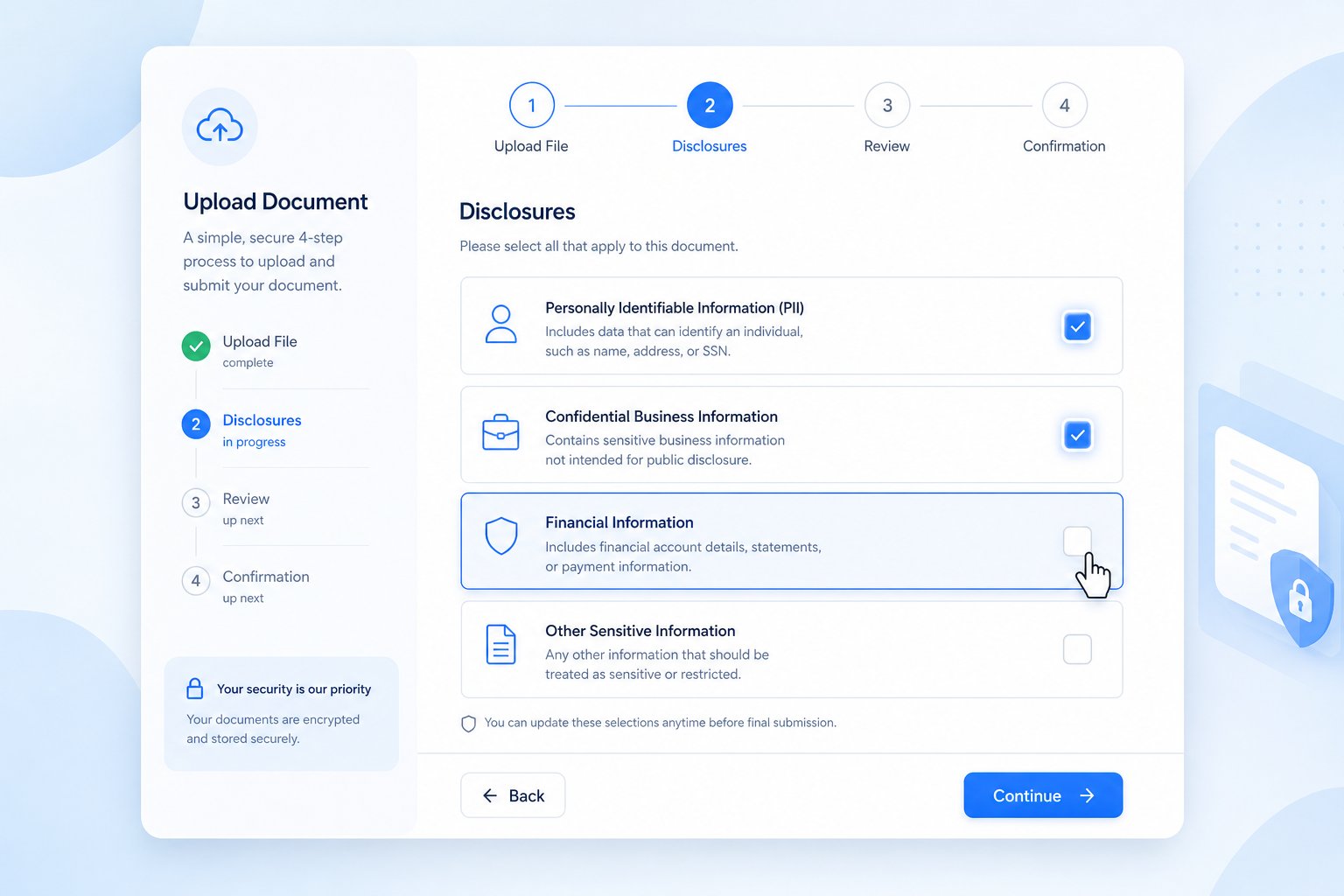
How to properly indicate AI-based content when uploading a file
Knowing the levels of AI involvement is one thing, but turning that knowledge into the right choices during upload is where most creators get lost. The AI disclosure process in DistroKid is integrated directly into the upload workflow, and your choices at this stage determine what metadata is passed to streaming platforms. If done correctly, your track will go live without issues. If you make a mistake or skip this step entirely, you risk facing subsequent content removal, which can escalate into serious account-level consequences.
Mandatory fields for disclosure during upload
When uploading a track to DistroKid, the platform now asks a direct question: Was any part of your music created using AI? This is not hidden in small print or behind an additional settings panel. It is a mandatory step in the upload process that you must complete before your release can proceed.
Here is a step-by-step guide to uploading a track using AI on DistroKid:
- Upload your audio file — drag and drop a WAV or FLAC file and fill in standard release details (title, artist name, genre, release date).
- Answer the AI generation question — DistroKid will ask if any part of the track was generated by AI. If your answer is "no," you proceed to the next step. If "yes," you move to the next selection.
- Specify what exactly was generated by AI — select at least one category from the following options: Lyrics (lyrics written by AI), Music (melody composed by AI), Entire Audio Material (everything the listener hears is generated by AI), or Part of Audio Material (some elements created by AI, some by humans).
- Specify your artist identity — if you select "Entire Audio Material," DistroKid will ask an additional question: Is your artist name a human or an AI character? Streaming services need this to correctly display artist information for your track.
- Submit for distribution — after completing the disclosure, your release will enter the standard review queue with attached AI metadata.
You will notice that the options are detailed enough to cover most real-world scenarios. A creator using AI to generate backing tracks but writing and performing vocals themselves would select "Music." Someone using an AI voice model with human-written lyrics would select "Part of Audio." The system is designed to work with hybrid workflows, not just binary "yes" or "no" situations.
It is worth noting one detail: you can add or update information about AI usage after uploading. If you missed any notification or made the wrong choice, go to your album page and click “Notifications” next to each song, or go directly to the AI usage information page on DistroKid to make corrections. This security system exists because the platform understands that honest mistakes happen, and it is better to allow creators to correct notifications than to punish them for an initial oversight.
Metadata and Tags: How Platforms Use Them
Your disclosure settings are not just stored in DistroKid's internal system — they are converted into metadata (tags) that accompany your release to all streaming platforms where it appears. This is where the requirements for music metadata imposed by streaming platforms using AI come into play.
Spotify launched beta testing of an AI tagging system in track credits in partnership with DistroKid, giving listeners the ability to see information about AI usage directly in the credits. Apple Music has implemented its own transparent tagging system, which is now mandatory for labels when delivering music. These platforms are creating listener-oriented AI tagging systems, and DistroKid's disclosure fields serve as the channel for transmitting this information further down the chain.
What does this mean in practice? When you select the “Lyrics” or “Musical Accompaniment” option during upload, this tag becomes a visible part of the content structure. It may appear in recording details, be considered by recommendation algorithms, or influence editorial decisions when compiling playlists. This metadata does not impose penalties — it serves as an informational basis. However, its presence means that your choices regarding disclosure have consequences beyond simply complying with DistroKid's upload requirements.
The self-disclosure model is entirely based on the good faith of creators. Failure to indicate AI usage does not mean that AI tools were not used — however, failing to disclose AI usage may lead to copyright sanctions and legal complications.
This topic deserves careful study. Currently, the system operates on trust: DistroKid asks questions, and you answer them. However, both DistroKid and streaming platforms use automated detection tools capable of identifying discrepancies between your statements and the results of audio file analysis. For example, Deezer has already implemented an automatic identification system based on artificial intelligence that does not rely on self-reporting at all. The broader industry is trending toward a shift from simple declaration to mandatory verification.
The main takeaway for creators is simple: the primary reason for rejection is incomplete or dishonest disclosure, not the use of AI itself. A properly disclosed, fully AI-generated track passes verification. An undisclosed one — even if the music perfectly meets all other standards — becomes a problem the moment automated detection or manual review reveals a gap. Accurately filling out the AI usage disclosure fields in DistroKid is not bureaucratic red tape. It is the most important step to protect your release and your account from future problems.
Nevertheless, proper disclosure does not guarantee trouble-free operation forever. Platforms update their rules, detection systems improve, and what passes verification today may face additional scrutiny tomorrow. Understanding what happens when a track receives a warning and how to respond to it is where preparation distinguishes resilient creators from those caught off guard.
Consequences of Rejection and Appeal Procedure
So, your track has been flagged as containing AI. Perhaps you forgot to check the box in the AI disclosure field. Perhaps DistroKid's automatic detection found something in your audio that did not match your statement. In any case, you received a rejection letter, and you are wondering how serious this is. The answer depends entirely on what caused the flag and what you do next.
What happens if your AI-based project is rejected?
A single rejection is not the end of the world. If DistroKid rejects your song, you will receive an email notifying you of a content policy violation. According to DistroKid's support documentation, the standard procedure requires you to remove the rejected release and re-upload it after resolving all identified violations. The rejection email contains details about what exactly went wrong; however, many creators note that the explanations are often overly vague—usually just a general reference to the policy rather than a specific technical analysis of the error.
Here is how the escalation path looks in practice:
- Initial Rejection — your track is flagged as problematic during review, you receive an email explaining the reason, and the release is not published on any platform. Your account remains in good standing.
- Opportunity to Correct — you delete the rejected upload, fix the issue (update rights information, correct metadata, or resolve copyright-related issues), and resubmit it as a new release.
- Repeated Violations — multiple uploads flagged as problematic within a short period trigger an account-level review. DistroKid begins to scrutinize your submissions more closely.
- Full Catalog Review — if systematic concealment of information or data falsification is detected, DistroKid may audit your entire catalog, potentially removing tracks that are already available on streaming platforms.
- Account Suspension or Termination — serious violations, such as unauthorized voice cloning, mass spamming, or intentional repeated data falsification, may lead to permanent account termination in accordance with DistroKid's Terms of Service.
What is the key difference? A one-time honest mistake—such as forgetting to select the correct AI crediting option—almost never leads to account suspension. DistroKid provides an opportunity to correct the error and resubmit the material. Those facing serious consequences are individuals who demonstrate systematic violations: submitting dozens of undeclared AI-generated tracks, repeatedly resubmitting the same flagged content without changes, or uploading voice clones of well-known artists.
Consequences of Multiple Violations at the Individual Account Level
Imagine you upload a track, get rejected, and immediately resend the same file, hoping it will pass review on the second attempt. Each rejection is recorded in your account. As reports from affected producers show, DistroKid's system tracks rejection history, and resubmitting flagged content indicates either ignorance of the rules or intentional circumvention. Neither scenario works in your favor.
Producers performing bulk uploads are at the greatest risk. Hundreds of AI-generated tracks submitted in rapid succession—a typical scheme associated with streaming fraud—can lead to immediate account closure without the usual escalation steps. DistroKid's automated systems are specifically configured to detect such behavior, as platforms like Spotify have removed over 75 million AI-generated tracks linked to fraudulent streaming activity.
For independent creators who use AI as a genuine creative tool, the threshold for serious consequences is significantly higher: it requires not a single violation, but systematic rule-breaking. However, it is important to remember that subsequent enforcement is a reality. DistroKid may remove already published tracks if it is later discovered that they do not comply with requirements. Royalties earned prior to removal may be paid out, but your account will be flagged for additional monitoring in the future.
Appeal Procedure and How to Use It
What should you do if DistroKid mistakenly classified your track? Perhaps your music was truly created by humans, but the automatic recognition system produced a false positive. Or maybe you used AI only for minor assistance—without needing to declare it—but the system still issued a warning. You have several options.
The appeal process at DistroKid is handled through their support system. Although there is no dedicated button on the platform for appealing AI-related rejections, you can contact the service team to contest the flag. The persuasiveness of your appeal largely depends on the quality of the documentation provided.
Here is how to properly compose an effective appeal letter if your track was mistakenly flagged as violating the rules.
- Document your creative process — session files from your DAW, project screenshots demonstrating arrangement decisions, individual tracks showing human performance. Anything that proves significant human involvement strengthens your position.
- Be specific about what you did — don't just say “I made this.” Explain which elements you composed, performed, or arranged. Describe the creative decisions you made beyond pressing the generate button.
- Honestly explain AI usage — if you used AI for mastering or minor enhancements, clearly state this. Demonstrating an understanding of the levels of AI involvement shows that you are acting in good faith.
- Provide proof of rights ownership — license confirmations from your AI tool, proof of commercial rights, or documentation of voice usage permissions, if applicable.
- Be professional and concise — support services handle a large volume of requests. A clear, factual message with attached evidence is resolved faster than a long emotional appeal.
One helpful tip: get into the habit of keeping documentation before you actually need it. Regularly save project files with dates, take screenshots of sessions working with AI tools, and save all settings in your DAW. If you are ever rejected, you will have everything ready in advance — and you won't be forced to hastily recreate evidence after a rejection.
The appeal process does not guarantee that the decision will be overturned; however, authors who can prove the authenticity of human authorship and lawful ownership of rights have every basis for having their status restored. The burden of proof lies with you — DistroKid will not conduct an investigation on your behalf — however, a carefully prepared appeal demonstrates that you are a legitimate author affected by the imperfections of the system, rather than someone trying to circumvent its rules.
This entire enforcement system exists for reasons that go beyond the policy of any single platform solution. DistroKid's rules do not operate in a vacuum — they reflect the rapidly changing legal framework concerning content created using artificial intelligence, ownership rights to copyrighted works, and the very concept of who can be considered the “author” of a musical work.
Legal Context of DistroKid's Artificial Intelligence Policy
The disclosure rules and compliance mechanisms on the DistroKid platform are not arbitrary decisions by the platform administration. They reflect a fundamental legal reality: under U.S. law, you can only distribute music for which you hold appropriate copyrights, and content created using artificial intelligence faces a serious deficit of rights that every author must clearly understand.
Can you register copyright for music created using artificial intelligence? The short answer is: no — if it is entirely machine-generated. It is this single legal fact that radically changes distributors' approaches to the use of AI-generated content.
U.S. Copyright Office Decisions on Authorship in the Field of Artificial Intelligence
The U.S. Copyright Office has been studying issues related to artificial intelligence and copyright since early 2023, and its position has only strengthened over time. In Part 2 of the Office's report, dedicated to copyright and AI, published on January 29, 2025, it was confirmed that works created entirely by AI are not subject to copyright protection. The requirement that the author be a human for AI-created music is not a recommendation, but a legal threshold determining whether your work will receive any protection at all.
This principle was tested in court in the case of Thaler v. Perlmutter, where a federal judge ruled that an AI system cannot be listed as the author of a work eligible for copyright protection. The D.C. Circuit Court of Appeals upheld this decision, and the Supreme Court declined to hear the case, leaving the requirement that the author must be a human intact.
Copyright protects original works of authorship; under U.S. law, only a natural person can be an “author.” Works created entirely by artificial intelligence are not subject to copyright, but works in which human authorship is combined with AI-generated materials may be registered, provided that the human-created elements possess a sufficient degree of originality.
What does a “sufficiently original” work look like in practice? The Copyright Office’s registration guidance clearly states that writing a text prompt does not constitute authorship. Entering the phrase “create an upbeat pop song about summer” into Suno or Udio, no matter how detailed your prompt is, does not grant you copyright over the result. The Office consistently maintains that users of generative AI systems “do not exercise ultimate creative control over” how the system interprets prompts.
However, if you write original lyrics, compose the melody yourself, perform vocal parts, or make meaningful creative choices in selecting, coordinating, and arranging AI-generated elements in the final work, these human contributions may be registered. You simply need to formally exclude the AI-generated parts using what the Copyright Office calls a “limitation of claim”—a statement indicating which parts were written by you and which by the machine.
How gaps in copyright affect your distribution rights
This is where the U.S. Copyright Office’s decision on AI-generated music directly impacts your uploads to DistroKid. Without copyright, you have no legal recourse if someone copies your track—none at all. A composition generated entirely by AI with no human authorship effectively falls into a “gray area”: anyone can use it, remix it, or even claim authorship—and you won’t be able to stop them.
Imagine how this affects the content distribution process. You upload an AI-generated track to Spotify via DistroKid. A user downloads it, then uploads the same track to another platform under their name through a different distributor and registers it in the Content ID system. As a result, their claim takes priority over yours. Without valid copyright registration confirming your ownership, you will have no legal basis to challenge their claim in court.
This isn’t about hypothetical scenarios: copyright and distribution rights for AI-generated music are inseparable. Distribution platforms like DistroKid must be confident that content passing through their system has a legitimate rights holder—a person who can officially authorize its publication on Spotify, Apple Music, and all other services where it will be available. When DistroKid requests confirmation of ownership upon upload, this question carries legal weight precisely because copyright law tightly links ownership to human authorship.
This has important practical implications and creates a clear incentive structure for content creators.
- Tracks created entirely by AI (with no human involvement) — distributed through DistroKid with proper disclosure, but not eligible for copyright protection. You risk having no legal protection against copying or unauthorized use.
- Tracks created with AI (using significant human creative decisions) — distributed and potentially eligible for copyright protection. Your original lyrics, melodies, arrangements, and performances qualify for registration. AI-generated elements are excluded from the application.
- Human-created tracks (AI used only for technical tasks) — fully eligible for copyright protection. AI-assisted mastering, noise reduction, or mixing help do not impose any restrictions on your copyright application.
Another optionDawn's DecisionThe Copyright Office’s ruling vividly illustrates this point. An author who used the Midjourney service to generate images received copyright only for their creative selection, coordination, and arrangement of those images—not for the AI-generated images themselves. The same logic applies to music: creative decisions regarding AI-generated material may be protected, but raw AI outputs are not.
What does this mean for your distribution strategy? It means that maintaining genuine human involvement in the creative process is not just a recommended practice for successfully passing DistroKid's review, but the only path to obtaining reliable, legally protected rights to your musical work after its release. A distributor can place your track on streaming platforms, but only copyright law can ensure its protection after publication.
This legal reality also explains why comparing different distributors matters greatly. Each platform interprets these rules in its own way, applies different levels of verification, and provides different protections for authors who fall into the zone between what is considered “fit for distribution” and what falls under copyright protection.
Which distributors allow AI-generated music?
Copyright law defines what is eligible for protection. However, it is the policies of music distributors that decide which materials actually reach listeners. Each platform interprets the issue of AI-created music differently: some openly welcome such content, others categorically reject it, and still others accept it under certain conditions that may change from quarter to quarter. If you are choosing the best distributor for songs created with AI, differences in policy, disclosure mechanisms, and infringement risks are more important than just the cost of services.
How each of the major music distributors approaches the issue of AI-based music
The difference in music policy between DistroKid and TuneCore AI turns out to be much more significant than most authors realize. DistroKid acts as the most flexible of the major distributors: it accepts fully AI-generated tracks provided a simple checkbox is marked during the upload process. In contrast, TuneCore does not accept tracks created entirely by AI without human involvement in the creative process—however, music using AI but with substantial human contribution passes their review.
CD Baby sets the strictest rules among all platforms. The platform, owned by Universal Music Group, completely bans music fully generated by artificial intelligence and accepts only those tracks where AI was used exclusively as an auxiliary tool in an artistic process initiated and controlled by humans. Comparing CD Baby's AI music policy with DistroKid's reveals two fundamentally different philosophies: one views AI as a legitimate creative method requiring full transparency, while the other sees it as a threat to human creativity.
Beyond this, there are mid-tier platforms shaping their own market position. UnitedMasters does not set any officially recorded restrictions on AI-created music—technically this is the most open approach among all distributors, but the lack of formal policy means protective measures could disappear without warning. Ditto Music accepts AI-based tracks provided authorship is clearly indicated; the service costs $19 per year and allows unlimited track uploads, making it a budget-friendly alternative to DistroKid. Amuse accepts AI-generated music at both free and paid access levels, but excludes AI-based content from the Meta distribution system and YouTube Content ID—which creates a significant gap in revenue for authors relying on social platforms to promote their work.
Here is how the six largest distributors compare on key metrics that matter most:
| Platform | AI Policy | Disclosure Required | Appeal Procedure | Account Risk Level |
|---|---|---|---|---|
| DistroKid | Supports music fully generated by artificial intelligence. | Yes — checkbox during upload (AI credits). | Technical request processing; resubmission after corrections | Low risk for disclosed content; high risk for undisclosed patterns. |
| TuneCore | Completely excludes content created solely by AI; allows content using AI assistance. | Yes — detailed attribution form specifying the AI tools used. | Resubmission with full disclosure is allowed. | Medium level; can distribute first and then recall. |
| CD Baby | Prohibits content created solely by AI; allows AI use only as an auxiliary tool subject to strict adherence to human authorship. | Must demonstrate substantial human contribution to the creative process. | No resubmission option for AI-generated content. | High sensitivity; active detection mode with low trigger threshold. |
| UnitedMasters | Currently, there are no officially recorded restrictions on the use of artificial intelligence in the music sector. | No special disclosure mechanism is provided or documented. | Standard technical support channels | Currently low level; policy may be tightened suddenly without prior notice. |
| Ditto Music | Accepted upon disclosure | Yes — during upload. | Standard technical support channels | Low risk for disclosed information |
| Amuse | Accepted upon disclosure; excluded from Meta systems and YouTube Content ID. | Yes — manual review at the upload stage. | Standard technical support channels | Medium level; manual review by specialists ensures stricter preliminary selection. |
Several patterns emerge from this comparison. All distributors today use automated AI content detection during the upload review stage—the difference lies in what happens after violations are detected. DistroKid uses this system to verify that the information provided by the author matches the audio content of the track. TuneCore uses it to enforce transparency requirements. CD Baby, however, uses the analysis results as grounds for outright rejection of the application.
How to Choose the Right Distributor for Your AI Music Workflow
Your choice depends on where your tracks fall on the AI involvement spectrum discussed earlier. If your workflow involves creating fully AI-generated compositions with appropriate metadata tagging, then unlimited track uploads to DistroKid for $22.99 per year and a straightforward process using checkboxes make this option the most convenient solution. The fixed pricing structure means the cost remains the same whether you release 5 or 500 tracks—a significant advantage for creators producing large volumes of AI-based content.
If your music creation process is more collaborative—with humans writing songs while using AI tools for arrangement or sound recording—almost all music platforms will accept your material. In this case, TuneCore’s more detailed authorship declaration form can be particularly useful: it allows you to clearly specify which elements of the composition were created with AI and which were not. This level of detail will help you protect your copyrights during subsequent platform reviews.
For creators aiming for maximum platform coverage, pay attention to exclusion lists. Currently, DistroKid and UnitedMasters are the only major distributors that do not list specific exclusions for AI-generated content on individual platforms. Amuse excludes Meta and YouTube Content ID. Other distributors, such as LANDR, additionally exclude TikTok, Deezer, and Pandora. If social promotion and user-generated content monetization are important to your strategy, these exclusions could cost you more than any subscription fee.
Important note: the situation is changing rapidly. The DDEX AI disclosure standard, promoted by Spotify with participation from DistroKid, CD Baby, Amuse, and others, standardizes the transmission of AI metadata throughout the distribution chain. Platforms that currently accept AI-generated music without mandatory disclosure are likely to tighten requirements as this standard is implemented. Before uploading, check the current rules directly with your chosen distributor, as the rules that applied to your last release may not apply to the next one.
Knowing which platforms accept your music is half the battle. The other half is understanding what makes an AI-assisted submission compliant rather than flagged; real-world examples of both scenarios help clarify where theory meets practice.
Compliant and Non-Compliant AI Music Submissions
Policy texts and classification levels can only help up to a point. What actually happens when you click the “Upload” button? Specific scenarios show where the line is drawn between successful publication and receiving a rejection notice—or worse, account action. Below are examples that directly correspond to the most typical situations faced by AI music creators on the DistroKid platform, each with a clear outcome.
Examples of Tracks Approved by DistroKid
All these AI-generated music examples approved by DistroKid share a common trait: full and honest disclosure, lawful copyright ownership, and no violations of personal data privacy.
Scenario 1: Fully AI-generated instrumental track with proper disclosure. You open Suno Pro, enter a detailed prompt to create a lo-fi ambient track, export the result, and upload it to DistroKid. During the upload process, you check the AI disclosure box, select “All Sound,” and confirm that your artist name represents a human identity. The track goes live. Suno Pro’s terms grant you full commercial rights to the output, you have honestly disclosed its origin, and nothing in the audio impersonates another artist. This is a model submission that meets all requirements.
Scenario 2: Human-written song with AI mixing and mastering. You wrote the lyrics, sang the vocals, and played the guitar. Then you processed the mix using an AI-based mastering service, such as LANDR Mastering, to improve quality. Is disclosure required? No. AI-based mastering, equalization, and noise reduction fall under the category of music creation tools, not generative AI. DistroKid treats this the same as using any other mixing plugin. No special checkboxes, no heightened review. Your song passes verification as a standard human-created release.
Scenario 3: AI-generated vocals using a licensed voice model. You create a track in your DAW, write original lyrics, and use an AI-based voice synthesis tool to generate vocals from a voice model that you trained on your own recordings—or one that you licensed from a platform providing explicit commercial permission. You select "Part of the audio" at the DistroKid disclosure stage. The track passes verification. Key factors: you can prove you own or have permission to use this voice, you disclosed the AI vocal generation, and the result does not imitate another person's voice.
Examples that are rejected or flagged as problematic
Rejections rarely arise from a single error—usually they are caused by a combination of issues: copyright infringement, inadequate disclosure, or violation of personality rights, which triggers automatic verification or manual review by DistroKid.
Scenario 4: Artificial intelligence creates vocals imitating the voice of a famous artist without permission. You use an AI-based voice cloning tool to create vocals imitating the voice of a famous singer. Even if you disclose the use of AI, this violates DistroKid's explicit prohibition on impersonation. The viral "Heart on My Sleeve" incident—when AI-generated vocals of Drake and The Weeknd were removed from all major platforms—clearly demonstrated how seriously distributors and streaming services take this. Expect immediate rejection and potential account-level consequences, especially if the impersonation is obvious or repeated.
Scenario 5: Track created using an AI tool whose license prohibits commercial distribution. This is a trap that catches more content creators than any other. You create a track on Suno's free tier—which explicitly limits use to personal, non-commercial use only—and upload it to DistroKid. Even with full disclosure of AI use, uploading violates the AI tool's terms of service. You do not possess commercial rights to this content, which means you cannot legally confirm ownership during the DistroKid upload process. If Suno or DistroKid systems detect this, the track will be removed. Worse, claiming rights you do not possess constitutes misrepresentation under DistroKid's terms.
Here is how these scenarios can be compared and analyzed side by side:
| Scenario | AI Level | Disclosure Required | Likely Outcome |
|---|---|---|---|
| AI tool (Suno Pro) with full disclosure of its capabilities | Fully AI-generated | Yes — "all audio material" | Accepted |
| Human vocals + AI mastering | AI-assisted production | No | Accepted (standard upload) |
| Vocal samples from licensed or own voice models | Partially AI-generated | Yes — "Part of the audio recording." | Accepted upon disclosure |
| AI cloning of a famous artist's vocals | AI human voice cloning | Disclosure irrelevant | Rejected + possible account action |
| Track from free AI tool (no commercial license) | Any level | Disclosure irrelevant | Rejected — distribution rights not granted |
Note the pattern in the rejection column. Rejection due to the use of DistroKid AI voice cloning technology does not depend on whether you selected the option correctly—voice impersonation is subject to a strict ban regardless of how transparently you disclose information. And any violation of license terms renders all other compliance steps meaningless. Even if you fill out all disclosure fields perfectly, if the terms of use of your AI tool do not grant rights for commercial distribution, you are building a house on a foundation that simply does not exist.
Why commercial license requirements for AI music generation tools are just as important as platform policies.
This aspect is often overlooked by many creators. DistroKid's policy complements the licensing terms of your AI platform but does not replace them. When you confirm during upload that you own 100% of the distribution rights, you are making a legal statement—and this statement depends entirely on what rights your generative platform actually grants you.
The differences between usage plans are significant. Suno's free plan restricts the use of generated compositions exclusively to non-commercial purposes. Suno Pro and Pro+ plans provide full commercial rights, including the right to distribute via streaming. Udio follows the same model—free versus paid plans. AIVA's Pro plan includes a special clause whereby AIVA waives all copyright claims to the created compositions—a stronger guarantee than what most competitors offer. Boomy takes a percentage of streaming revenue as part of its collaboration model.
Before uploading anything to DistroKid, check the following three points regarding your AI tool:
- Does your subscription plan include rights for commercial distribution? Free plans almost universally restrict the use of outputs to personal use only.
- Does the tool retain any ownership rights to the outputs? Some platforms reserve broad rights to outputs generated under the free tier, including using your outputs for advertising purposes.
- Are there revenue-sharing obligations? Platforms like Boomy take their share, which does not prevent distribution but changes your financial calculations.
A tool that retains ownership of its outputs makes it impossible to distribute the music files—regardless of how you publish them on DistroKid. This is why AI-generated music often fails moderation on DistroKid, even if creators believe they have met all requirements. They strictly followed the platform's upload instructions, checked all necessary boxes, and provided honest descriptions—however, the track lacked valid commercial rights from the start because it was created on a free plan or on a platform whose terms of use do not allow for distribution.
The safest workflow begins with verifying access rights even before opening your DAW. Ensure that your AI tool's license is valid, choose a subscription plan that covers all necessary features, and save documents confirming your subscription status at the time of content generation. Such proof will be critically important if, months after the track's release, its copyright is challenged in the future.
Once the relevant applications are processed, the remaining question shifts from "Can I distribute this content?" to "How do I create a workflow that generates AI-based music ready for distribution from the start?"—a process where licensing, disclosure, and creative work are aligned long before reaching the upload screen.
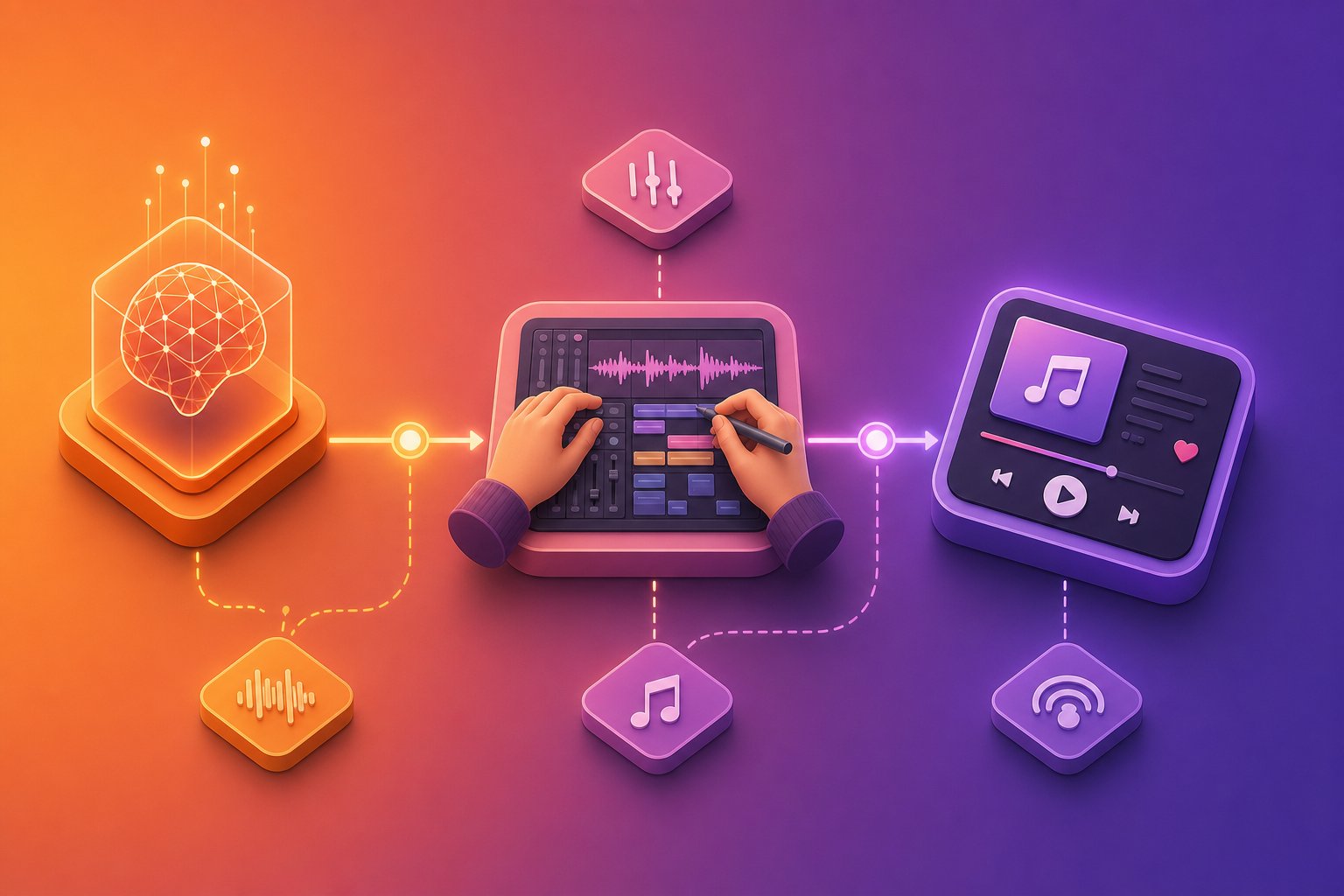
Creating AI Music Ready for Distribution from the Start
Addressing compliance issues after they arise is an extremely stressful process. However, creating a workflow that produces tracks ready for distribution from the start allows you to completely avoid most of these difficulties. Creators who never face rejections or need to file appeals are not just lucky—they have simply organized their process so that copyright, disclosure, and creative involvement issues are addressed before the files even reach the DistroKid upload screen.
The formula is simple: start with a tool that grants you the necessary rights, incorporate meaningful human creative direction throughout the process, and systematically document every stage of work. Each of these three pillars addresses one of the key issues—license agreement violations, copyright gaps, and disputes related to disclosure—that we have already discussed in previous sections and which have repeatedly become obstacles for creators.
Creating an AI Music Generation Workflow Ready for Distributed Deployment
How do you prepare AI-generated music for distribution? Think of this process as a multi-layered procedure, where each stage adds both creative value and legal protection.
Start with a targeted creative approach. Even if AI generates the raw musical material, your workflow should include decisions that go beyond simply entering a single prompt. Select specific elements from multiple options. Rearrange sections. Change the key or tempo. Add your own performance—a vocal part, a guitar part, a drum pattern. Each of these choices represents a form of human authorship that strengthens both your copyright and your position should the track ever be challenged.
Treat the AI output as raw material, not a finished product. The most sustainable AI music creation workflow for uploading to DistroKid mirrors how producers have always worked with samples and loops. You generate material, then process it. Perhaps you take a chord progression from one AI-generated option, a rhythmic feel from another, and combine them with original melodies you wrote yourself. The result is truly yours, which would never be the case if you simply exported based on a single prompt.
Document your process in real time. Save screenshots of your DAW sessions showing arrangement decisions. Keep multiple AI-generated options along with notes on why you chose one over another. Record the prompts you used and the changes made to the output. This documentation serves two purposes: it proves human authorship if your copyright is ever disputed, and it provides evidence for appeals if DistroKid’s automated detection mistakenly flags your track.
The Grammy Awards standard offers a useful benchmark here—they require “meaningful and more than de minimis” human creative contribution for AI-generated music to qualify. You don’t necessarily need to meet this criterion for distribution via DistroKid, but striving for it will give you the strongest possible position in terms of copyright registration, platform compliance, and audience trust.
Choosing AI Tools with Distribution-Friendly Licenses
The reliability of your workflow directly depends on the quality of the tool you use. Even a perfectly crafted and professionally produced music track cannot be successfully distributed if the AI generator’s license does not grant commercial rights. Choosing the best AI music generators with commercial licenses is the most important strategic decision at the initial stage of your work.
When choosing royalty-free AI-based music tools for commercial use, pay attention to the following key features:
- SongAI’s Free Music Generator — provides ready-to-use, royalty-free musical materials for videos, podcasts, games, and social media. This is a practical starting point for content creators who want distribution-ready material without subscription fees or revenue-sharing obligations.
- Commercial distribution rights clearly stated in the Terms of Service — not just “commercial use” in a broad sense, but specific wording that permits uploading to streaming platforms via distributors. Some tools allow commercial use in videos but restrict independent music distribution.
- No revenue-sharing requirements that complicate your DistroKid earnings — platforms like Boomy take a percentage of streaming revenue, which is acceptable but adds administrative complexity. Completely free tools ensure transparency in your revenue structure.
- Clear transfer of ownership in the plan you use — check whether the tool retains any rights to the generated content. An ideal license clearly states that you own the output and the platform waives any claims. As clearly stated in Suno’s documentation, ownership rights differ significantly between free and paid tiers—free plan outputs belong to Suno, while Pro/Premier subscribers own their created works.
- No restrictions on derivative works or modifications — you want the freedom to edit, rearrange, combine with other elements, and transform AI outputs without encountering licensing restrictions.
- Documentation-friendly operation — tools that provide creation history, timestamps, or export logs make it easier to prove your creative process if questions arise.
The most common licensing trap most creators fall into is assuming that “free to use” is equivalent to “free for commercial distribution.” In reality, these are different rights. For example, a particular tool may allow using generated music in YouTube videos under a Creative Commons license, but simultaneously strictly prohibit its independent distribution on platforms like Spotify or Apple Music. Always carefully review the specific distribution terms—not just the general permissions stated in broad wording.
Before uploading anything, here is a useful check: can you honestly confirm to DistroKid that you fully (100%) own the distribution rights to the material? If the terms of use for your AI tools create uncertainty on this issue, you risk encountering problems weeks or months after release—possibly even after receiving royalties that may need to be returned.
Combining a rights verification tool with a human-led creative process provides the most reliable foundation. You comply with DistroKid's ownership requirements, create original content eligible for copyright through thoughtful creative decisions, and always have documentation on hand in case of any audits or disputes. This is not just about rule compliance—it is a well-thought-out workflow designed to scale without accumulating hidden legal risks with each new release.
All Together — As an AI-Based Music Creator
You have already reviewed the policy, access levels, upload process, rejection scenarios, legal framework, and distributor ecosystem. The core idea running through all of this is simple: DistroKid accepts music created using AI only if three rules are followed—honest disclosure, lawful rights to the material, and significant human creative contribution. If you violate even one of these rules, the system will work against you rather than for you.
Key Takeaways for Distributing AI-Generated Music
Each section of this guide confirms the same practical truth. Below is a checklist for distributing AI-generated music for creators who want to avoid publication rejections and build a catalog that remains permanently available.
- Disclosure prevents problems; hiding them creates them. Properly disclosed AI-generated tracks pass verification. Undisclosed ones become a burden the moment automated detection identifies a discrepancy. The system currently operates on trust, but verification technologies are rapidly improving.
- Your AI tool's license is as important as DistroKid's policy. If your generator does not grant rights for commercial distribution under your current subscription plan, no amount of proper disclosure will fix the gap in ownership rights. Free tier limitations are the most common pitfall.
- Human creative direction strengthens every level of protection. It satisfies disclosure requirements, enhances copyright eligibility, provides documentation for appeals, and results in better music. There are no downsides to maintaining genuine artistic involvement.
- One honest mistake will not destroy your account. DistroKid's escalation path gives you opportunities to correct issues before consequences become severe. Bans result from systematic misrepresentation, not isolated errors.
- Copyright protection requires human involvement. You can distribute a track entirely created by AI, but you cannot protect it with copyright. Anyone can copy a work unprotected by copyright without legal consequences. This risk increases with every publication lacking significant human contribution.
Recommended Next Steps for Creators
Ready to distribute AI-generated music on DistroKid without worrying that your next upload might lead to an account ban? Follow these steps to confidently distribute AI-generated music:
- Choose a royalty-free AI tool with explicit rights for commercial distribution. SongAI's free music generator offers royalty-free results permitted for commercial use—a reliable starting point that eliminates licensing uncertainty before your creative process even begins.
- Create material, then process it. Use AI outputs as source material. Arrange segments, layer original parts, adjust tempo and key, rewrite lyrics, or combine elements from multiple generations. Each decision adds human involvement.
- Document your creative process as you work. Take screenshots of DAW sessions, save generation logs, and keep notes on your editorial decisions. This evidence will protect you during appeals and assist with future copyright registration.
- Verify ownership rights before uploading. Ensure your subscription level grants rights for commercial streaming distribution. Check for clauses regarding revenue sharing or platform retention of rights. If there is any uncertainty, resolve it before clicking the "Submit" button.
- Accurately provide information during the DistroKid upload process. Select the correct AI authorship categories—lyrics, music, entire audio file, or part of the audio file. When in doubt, disclose more rather than less.
- Release tracks at a natural pace. Avoid bulk uploading similar tracks in short intervals. A measured release schedule demonstrates genuine creativity rather than algorithmic spam.
These steps are not just about avoiding music rejection on DistroKid due to AI use. They aim to establish a sustainable creative practice where each new release possesses lawful rights, accurate metadata, and genuine artistic value.
The future of AI-based music distribution policies will be determined by standardized verification systems, not just voluntary disclosure. Creators who today create transparent and thoroughly documented workflows are thereby preparing for a future environment where confirmation of human participation will become a mandatory requirement, not just an optional practice.
Rules will continue to evolve: platforms will tighten violation detection systems, new legal precedents will rewrite the boundaries of copyright, and disclosure standards will become increasingly detailed. However, those creators who successfully adapt to these changes are those who view artificial intelligence as a creative partner rather than a replacement for artistic vision, and who document this collaborative creative process at every stage of their work.