
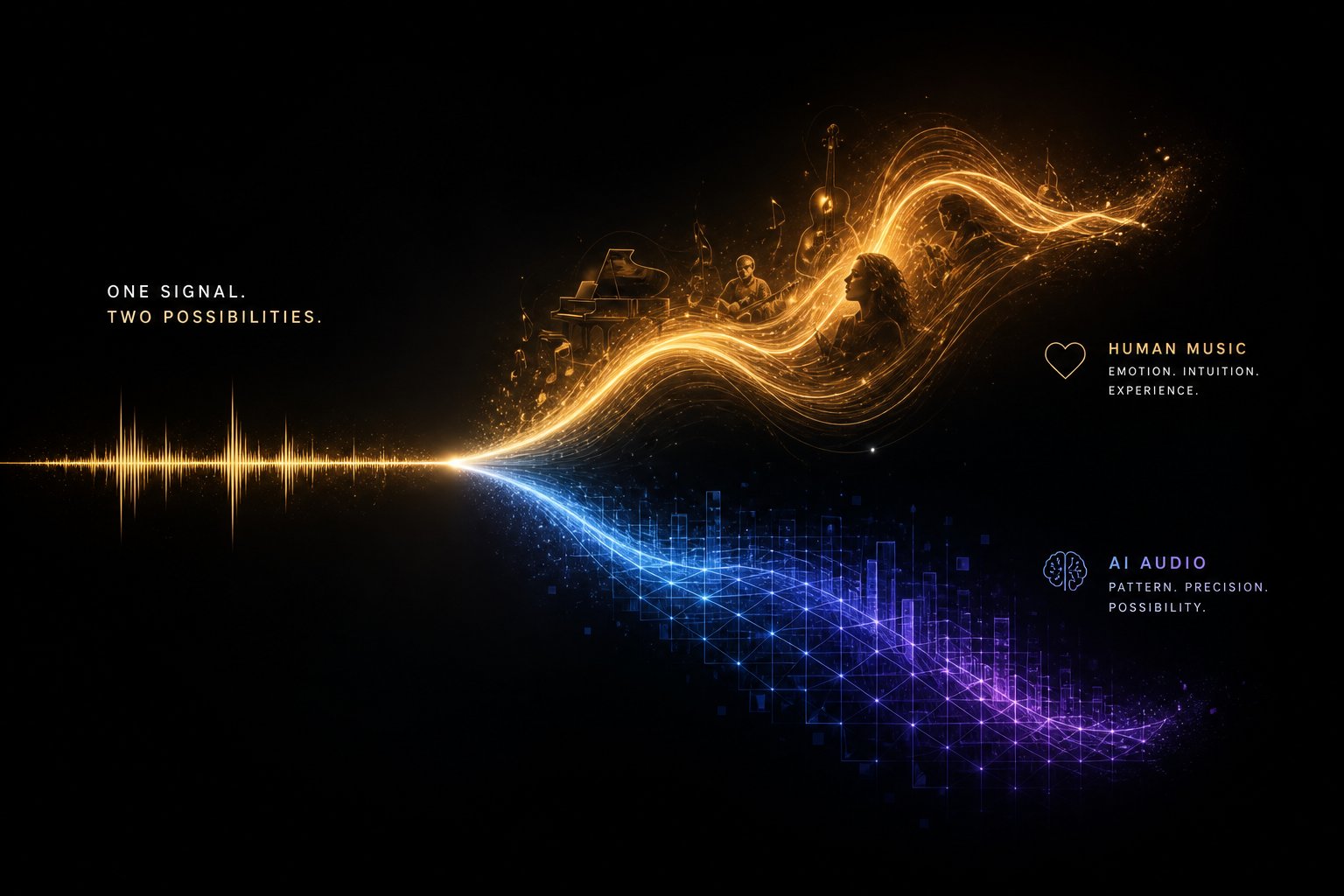
Why It’s More Important Than Ever to Understand Whether Music Is the Product of Artificial Intelligence
Imagine you’re browsing a playlist and wondering: Was this song created by artificial intelligence, or did a living person pour their soul into it? Not long ago, this question seemed purely hypothetical. Now, things are different. AI-generated tracks are flooding streaming platforms at a speed that would have seemed unthinkable just two years ago, and distinguishing them from human-made music has become a real challenge for everyone—listeners, playlist curators, and musicians alike.
The statistics paint a telling picture. Streaming service Deezer receives nearly 75,000 AI-generated tracks daily, accounting for 44% of all new music uploaded to the platform. That’s more than 2 million synthetic tracks per month—and that’s just on one service. The growth has been rapid: the figure rose from 10,000 uploads per day in early 2025 to the current 75,000, a 650% increase in just 16 months. Meanwhile, Deezer is one of the few platforms openly publishing such data; other major services have not yet disclosed comparable information.
According to research commissioned by Deezer, in blind tests, 97% of listeners could not distinguish between AI-generated music and human-composed music. At the same time, 80% of respondents believe that fully AI-generated music should be clearly labeled as such.
It is precisely this gap between what people want (transparency) and what they can actually recognize (very little) that has turned the ability to distinguish AI-generated music from a niche interest into a practical necessity. In online music communities, there is growing concern that “things are bad” with AI music: listeners are beginning to realize the volume of synthetic content surrounding them, often without any clear labeling.
Why the Ability to Recognize AI-Generated Music Has Become a Key Professional Skill Today
Identifying such content is critically important because the consequences are very real. AI-generated content dilutes the royalty pool for real artists under the pro-rata revenue distribution models used by services like Spotify, Apple Music, and others. When synthetic tracks—even those artificially inflating streams through fraud—gain popularity, they take away income from musicians who spent months writing and recording their works. Artist rights organizations worldwide are sounding the alarm: according to studies by CISAC and PMP Strategy, up to 25% of music creators’ income could be at risk by 2028, with potential damages amounting to 4 billion euros.
Meanwhile, listener attitudes are also changing. A Luminate study reported by NPR showed that between May and November 2025, overall interest in AI-generated music declined (the metric dropped from -13% to -20%), with the sharpest decline observed among Gen Z and Gen Alpha. People increasingly dislike AI-generated songs, especially those mimicking the style of well-known artists. Against this backdrop, the need to understand how to distinguish AI-generated music from genuine human-created music is also growing.
Who Should Identify AI-Generated Tracks?
This is not an issue affecting just one audience. Several different groups encounter it daily.
- Music lovers who want to know whether the tracks in their playlists were truly created by talented artists deserving of support.
- Playlist curators and Artists & Repertoire (A&R) specialists who review hundreds of music submissions—many of which are now created in just seconds using tools like Suno and Udio.
- Independent musicians concerned that copies of their style or vocals, generated by artificial intelligence, may appear on the same platforms.
- Educators and music students striving to understand how to determine whether music was created by artificial intelligence or performed by a human.
Here’s the honest truth: some AI-generated musical compositions are indeed difficult to recognize—especially given the continuous improvement of generators with each update. No single method is sufficient to detect all cases. However, a comprehensive approach combining audio signal analysis, contextual clues, platform-specific features, and specialized detection tools allows for the identification of the vast majority of synthetic tracks. In this guide, we systematically break down such an approach—from quick checks that can be done in seconds to deep analytical methods capable of revealing what is hidden in the final mix.
Spectrum of Artificial Intelligence Involvement in Music Production
To learn to recognize music created by artificial intelligence, you need to understand: AI involvement is not a question that can be answered with a simple “yes” or “no.” There is a whole spectrum of possibilities here, and how easily a composition can be identified depends on how it was created. A track fully generated from a text prompt has completely different characteristic features than a song written by a human but mastered using an AI plugin. Understanding where a composition falls on this spectrum determines which detection methods will be effective.
Fully AI-Generated Tracks and What Defines Them
So, how does AI music generation work in a fully automated mode? With tools like Suno and Udio, users can enter a short description, select a music genre, and receive a finished song within seconds. The AI handles all the work—from melody and harmony to instrumentation, vocals, lyrics, mastering, and structure. Human contribution is limited to entering the prompt and possibly making minor edits to the result. No one plays instruments, no one records parts, and no one makes creative decisions—AI does all of this exclusively based on the initial input.
It is in this case that detecting artifacts proves most feasible. Fully AI-generated tracks contain the highest number of artifacts because every element passes through the same generative model. There is no human performance to impart a sense of reality, nor are there session musicians contributing micro-nuances that algorithms struggle to reproduce.
AI-Assisted Music vs. Fully Human Creativity
The middle zone of the spectrum is where things get most interesting. AI-assisted music keeps the human as the primary creator, with AI helping to perform specific tasks. For example, a songwriter might use an AI-powered app for writing lyrics and melodies to generate ideas for chord progressions, but they write and perform the final track themselves. Or a producer might process a mix using AI-based mastering software, such as LANDR. The creative core remains in human hands—AI performs supportive tasks.
As RouteNote explains, the key difference lies in control. In AI-assisted workflows, it is the artist who controls the workflow, makes decisions, and shapes the final product. A prime example is The Beatles’ Grammy-winning composition “Now and Then”: although AI technologies allowed John Lennon’s vocals to be isolated from old demo recordings, the songwriting, arrangement, and production were handled by humans.
In such cases, detecting AI intervention becomes much more difficult, as human performance and creative decisions mask any background processes performed by artificial intelligence. When analyzing such a composition, specialized AI tools will detect authentic characteristics of the human voice, natural instrument dynamics, and organic micro-fluctuations in tempo throughout the track.
Where Boundaries Blur
Between these two poles exists a hybrid category. Imagine a person who uses AI to create an instrumental foundation, then writes their own lyrics and records vocals over that foundation. How are songs created with AI involvement in such an intermediate model? This work is part machine, part human, with significant creative input from both sides. Can AI create music better than humans in such collaborative scenarios? This question almost loses its meaning, as the result is neither purely human nor purely machine-made.
This spectrum has important practical implications, as platforms develop multi-tiered policies for it. Spotify’s AI disclosure framework, built on the industry-standard DDEX, allows artists to specify where and how AI was used—in vocals, instrumentation, or post-production. Distributors like TuneCore block content created entirely with AI but accept tracks using AI as an assistive tool, while DistroKid generally accepts music created using artificial intelligence, subject to disclosure requirements.
| Category | Level of Human Involvement | Common Tools | Detection Difficulty |
|---|---|---|---|
| Fully AI-Generated | Minimal mode (prompts only) | Suno, Udio, Boomy | Moderate or Low |
| Hybrid | Significant editing work and performance enhancement | AI instrumentals + human vocals and lyrics | High |
| AI-Assisted | Initial creativity is human-driven. | LANDR — AI-based music mixing plugins and AI-powered automatic chord selection tools | Very High |
| Fully Human | 100% | Traditional musical instruments and Digital Audio Workstations (DAW) | N/A |
Understanding how artificial intelligence creates music at different levels of this scale is the foundation for all subsequent analysis. Detection methods capable of identifying a fully Suno-generated track will not necessarily recognize an AI-assisted product, and vice versa. A multi-level detection approach works precisely because it uses different tools to analyze various points on this spectrum. The most logical starting point is audio characteristics that reveal signs of a purely synthetic track—these require careful and specifically trained listening.

Audio: Typical Signs You Can Learn to Recognize by Listening
When you ask yourself, “Does this sound like music created with artificial intelligence?” while playing a composition, your intuitive perception picks up on something real. AI-generated music leaves measurable acoustic “fingerprints” that even trained ears can learn to recognize. A review article based on the analysis of 12,400 music tracks, peer-reviewed and published in the Journal of the Audio Engineering Society, identified three statistically significant anomalies associated with AI-generated content. These are not subjective impressions, but reproducible and measurable deviations observed regardless of genre, tempo, or loudness normalization.
The key to learning to recognize AI-created music lies in understanding that AI models simulate human musical performance without experiencing the physical limitations that shape human performance. Humans experience fatigue, fingers may tremble, and vocal cords strain—all of which are present in live performances. Artificial intelligence, on the other hand, bypasses all these factors, and it is this absence of physical constraints that leaves certain traces in the sound.
Vocal Artifacts That Reveal AI Presence
In vocal accompaniment, artificial intelligence struggles most with sounding truly human. To determine if a voice is AI-generated, pay attention to the following characteristic signs:
- Inconsistent vibrato decay: The amplitude of human vibrato naturally decreases over the duration of long notes due to diaphragm fatigue. In digitized vocal samples created by AI, the depth of vibrato often remains constant or disappears entirely. On a spectrogram, human vibrato is characterized by a gradual decrease in peak amplitude in the 5–7 Hz range, whereas AI generation shows either flat or stepped curves.
- Mechanical breathing patterns: Breathing is either completely absent or repeats at strictly regular intervals with identical strength and duration. Real singers breathe irregularly—the depth of breaths depends on emotional intensity.
- Exaggerated sibilance: Every “s” sound has the same sharpness and duration. In human speech, the character of sibilant sounds changes depending on mouth position, articulation intensity, and phrasing.
- Emotional emptiness beneath personal expressiveness: The voice is technically capable of conveying dynamics, but the micro-variations necessary to convey genuine emotions—such as subtle cracks in timbre, slight tonal shifts in the middle of a phrase, or imperceptible pitch fluctuations when pronouncing emotional words—are either absent or formulaic.
- Monotonous vibrato on repeated notes: When the same lyrics appear in different verses, AI systems often reproduce virtually identical vibrato patterns. However, real singers never repeat the same sound or phrase verbatim.
If you wonder how AI manages to create a sound so close to human, the answer lies in statistical modeling. Such systems analyze millions of audio recordings to learn typical vocal features, but they fail to capture those rare yet expressive moments that give a performance the feeling of living breath. An AI song lyric detector can identify suspicious textual patterns, but for recognizing these vocal signs, the human ear remains the best tool.
Critical Issues in Sound Engineering and Recording
In addition to vocals, musical instruments also contain distinctive features that allow them to be identified. Below are the key characteristics to pay attention to when trying to identify AI-generated music at the instrumental level:
- Decay of drum transients: Real hits on the snare drum and hi-hat create transient peaks lasting less than 10 ms with rich high-frequency harmonics above 8 kHz. AI models often blur these attacks, creating softened hits lacking harmonic sharpness.
- Truncation of the harmonic series in bass: Acoustic basses and pianos generate strong odd-order harmonics (3rd, 5th, 7th) below 200 Hz. AI models trained on compressed streaming data often cut off harmonics above the 3rd order, resulting in a thin low-frequency texture.
- Unnatural decay of guitar strings: Real guitar notes decay depending on string thickness, pick attack, and body resonance. AI-generated guitar notes often decay at the same rate regardless of playing dynamics.
- Stereo field that never shifts: In human-created tracks, instruments subtly move within the stereo image as performers change position or sound engineers automate panning. AI mixes tend to lock each element in the same position throughout the song. Overly perfect mixing balance: everything is at a suspiciously stable level. Real mixes breathe, with elements moving forward and receding as the arrangement develops.
These recording anomalies help determine whether a song is the result of AI processing, especially when the vocals alone do not provide a definitive answer. The combination of softened transients, truncated harmonics, and a static stereo image creates a sense for the listener that something is not quite right—even before they can clearly identify individual artifacts.
Song Structure Patterns That Create a Sense of Dissonance
Look beyond individual sounds and listen to how the composition evolves over time. Songs created by artificial intelligence often follow correct structural templates (verse – chorus – verse – bridge – chorus), but they lack the emotional logic that connects these parts into a cohesive whole.
- Verses that do not build in intensity: Each verse delivers the same energy level without the gradual increase that pushes listeners toward the chorus.
- Bridge transitions that seem disconnected: The bridge exists because the formula requires it, not because the song emotionally demands a resolution before the final chorus.
- Harmonic sequences using template patterns: Chord changes follow statistically common progressions without the unexpected choices that give human songwriting its individuality.
- Mechanically precise transitions: Section changes occur at exact intervals without the slight "push" and "pull" characteristic of human arrangements that respond to their own dynamics.
No single indicator in this list can definitively confirm AI origin on its own. For example, heavily quantized pop music may exhibit some of these signs, while a well-crafted AI output may avoid the most obvious markers. The most reliable approach is to combine multiple signals. When you hear even vibrato decay against blurred drum transients and a bridge that evokes no emotion, the evidence quickly accumulates. Train your ear on these musical examples—and then the question will no longer be whether you can recognize synthetic music, but rather how many layers of sonic detail you can notice in a single listen.
However, audio analysis has its limitations. With each model update, these signs become increasingly subtle, and some tracks simply cannot be detected by ear alone. This is where contextual and platform signals come into play—they help trace the necessary clues.
Platform and Contextual Signals Beyond Audio
To determine whether a track is synthetic, you don't always need to analyze the frequency spectrum in detail or study vibrato patterns. Sometimes the most telling signs are not in the music itself, but in the artist's profile, release history, and digital footprint—or the lack thereof. For playlist curators who review hundreds of music submissions weekly, such contextual signals often serve as the first filter—long before anyone hits the play button.
Imagine it this way: a real musician leaves traces everywhere — years of social media posts, blurry concert videos, collaborations, interviews, mentions in the credits of other people's tracks. AI musicians, on the other hand, usually appear fully formed, without any past experience or biography. This very absence of history tells its own story.
Artist Profile: Red Flags on Streaming Platforms
A vivid example of this is the story of the band The Velvet Sundown, which unfolded in 2025. The group amassed hundreds of thousands of monthly listeners on Spotify after releasing two albums just weeks apart, but internet detectives noticed some telling details: no information about live performances, no photos or videos from concerts, no personal social media pages for the band members, and no interviews. In promotional photos, the musicians' faces were heavily retouched, and the backgrounds featured generic landscapes bathed in warm orange light. It eventually turned out to be an artificially created project, with music and vocals generated using artificial intelligence technologies.
If you want to find out whether a new, lesser-known artist is real, pay attention to the following signs characteristic of their profile:
- Lack of social media activity: Real artists almost always maintain at least one active account. Creators of AI-based projects rarely spend effort building a convincing social media presence spanning months or years.
- No history of live performances: Look for information about concerts, venue tags, amateur videos, or festival appearances. Their absence is a serious red flag.
- No interviews or press mentions: Even small independent artists eventually get blog posts, podcast features, or mentions in local press.
- Generic or AI-generated profile photos: Watch for unnaturally smooth skin, uneven lighting, backgrounds without recognizable locations, or that same "uncanny" uniformity across all promotional shots.
- No "About" section or biography with verifiable facts: Vague descriptions that don't mention hometown, musical influences, or key career milestones indicate a fictional persona.
These checks take only a few seconds and immediately narrow down the candidates. How many AI musicians are currently operating without any real reference points? Their number is growing rapidly, but their profiles betray themselves through obvious emptiness — especially if you know what to look for.
Release Patterns and Metadata as Traces
The release rhythm is one of the most reliable behavioral signals. A human artist might release albums once a year or every three years, and singles every few weeks or months. AI-generated catalogs follow a completely different timeline. The case of streaming fraud involving Michael Smith involved hundreds of thousands of AI-generated songs uploaded to music platforms; each was played only to the minimum extent necessary — enough to accrue royalties but not raise suspicion. Such volume is simply physically impossible for a human creator.
Pay attention to the following risk indicators in release patterns:
- Releasing dozens of tracks within days or weeks: even the most productive human musicians cannot write, record, mix, and master at such a pace.
- Simultaneous release of multiple albums: Professor Gina Neff from the Minderoo Centre at the University of Cambridge described a case of a suspected AI performer who released several albums at once with a homogeneous sound resembling "real classic rock hits put through a blender."
- Generic or template-like track titles: names like "Lo-Fi Study Beat 47" or "Chill Ambient Mood 12" are typical of mass AI content generation.
- Distributor names associated with AI music "farms": some smaller distributors are known for processing huge volumes of AI-generated content with virtually no prior verification.
- No registration with rights management organizations: professional songwriters register with organizations such as ASCAP, BMI, PRS, or their equivalents. AI-created tracks often list unregistered names or lack author information entirely.
According to a Chartlex study focused on 2026 detection systems, indicators such as mass assignment of ISRC codes, cover art matching AI image generation templates, and the use of standard genre tags combined with high upload speed are among the most reliable indicators. Distributors use them to identify suspicious content before it reaches streaming platforms.
Social Proof and Collaboration Signals
Music is inherently a collaborative art form. Real artists build complex networks of professional connections around themselves: featured vocalists, renowned producers, sound engineers, session musicians, songwriting collaborators—all contribute to the creation of music. However, musical groups and solo projects created with AI typically do not reflect this multifaceted teamwork. The "Credits" section either contains no information at all or lists the same name for all roles.
Here is a platform-specific checklist for verifying core services.
- Spotify: Examine the "Track Info" (Credits) section. Pay attention to the names of producers, mixing engineers, and mastering specialists. Check whether the artist appears on recordings by other artists and compare the number of playlist saves to the number of streams.
- Apple Music: Review the artist page: check for social media links and a verified biography, and see if the track is marked with Apple’s special transparency labels (introduced in May 2026) as AI-generated or AI-assisted.
- YouTube: Look for official music videos with real performance footage, behind-the-scenes content, or live session recordings. Browse comments for fan messages about real-life encounters with the artist.
Anomalies in streaming add another layer of complexity. If an artist has 500 tracks but nearly zero playlist saves, minimal social media engagement, and lacks the subscriber growth characteristic of organic discovery, this behaviorally matches the profile of an AI-generated artist. Real listeners save songs, share them, add them to personal playlists, and follow artists they like. When stream counts exist in isolation from such engagement signals, it indicates that something is amiss.
These contextual checks complement audio analysis and often work faster. A curator can scan a profile in thirty seconds and decide whether deeper listening is warranted. However, for tracks that pass both audio and contextual checks, there is a more precise approach—identifying which specific AI generator created the music based on its unique sonic signature.

How Different AI Generators Leave Their Unique Digital Footprints
Each AI-based music generator uses unique internal sound processing mechanisms, and these architectural differences leave characteristic “sonic fingerprints,” akin to an artist’s brushstrokes. The ability to identify the source platform from such a fingerprint allows moving beyond the simple question “Was this created by AI?” to a precise answer: “Which specific AI created this?”. Such specificity significantly increases confidence in detection results.
Two leading platforms—Suno and Udio—use fundamentally different generation architectures. According to spectral analysis conducted by Authio, these differences are not limited to superficial features: they produce artifacts that persist even after post-processing or format conversion. Smaller platforms like Boomy and AIVA also have their own specific markers. The ability to recognize each generator’s “handwriting” is akin to identifying a specific recording studio by its characteristic room sound.
Identifying Musical Tracks Created by Suno
Suno uses a diffusion-based architecture that generates certain characteristic artifacts detectable through careful listening and spectral analysis. If you have ever taken a training course on Suno AI and listened closely to its outputs, you have likely noticed some of these patterns.
- Characteristic 32 kHz Sampling Rate Signature: Suno operates with an original sampling rate of 32 kHz and then performs upsampling to 44.1 kHz for audio output. This results in a sharp spectral cutoff at the 16 kHz mark, which differs from the natural high-frequency roll-off typical of acoustic recordings. In human-created music, this roll-off occurs gradually, whereas with Suno, the signal level drops abruptly.
- Digital “Haze” in the 8–16 kHz Range: The diffusion process introduces characteristic noise with uniform energy distribution, not found in natural audio. Early versions of Suno (v3 and v3.5) exhibited more pronounced “phasey” or “metallic” artifacts—especially where hi-hat sounds overlapped with sibilant vocal sounds, creating an effect that sound engineers call “spectral mush”.
- Temporal Stability: Audio generated by Suno exhibits unusual stability in energy levels over time. Real recordings contain microdynamics—tiny fluctuations in energy and spectral composition arising during live performance. Suno smooths out these nuances, creating an almost eerily uniform sound.
- Excess Energy in the Lower Midrange: Suno v5 often shows congestion in the 200–500 Hz range, giving the sound a certain muddiness immediately noticeable to experienced sound producers.
- Tendency Toward a “Polished” Pop Sound: Suno targets the aesthetic of radio hits, using characteristic reverb settings and vocal processing; they sound professional but formulaic. The character of the reverb tail and vocal compression follow predictable patterns common across genres.
The new Suno v5 model line has significantly reduced many of the most noticeable artifacts of previous versions, especially the metallic tone and high-frequency noise. However, the characteristic feature of 32 kHz upsampling resampling and excessive temporal predictability remain structural limitations of the architecture itself.
Signature Share and Differences Between Them
Udio uses a transformer approach to music generation, which results in the formation of a completely different set of recognizable musical patterns. In discussions on Reddit communities dedicated to AI-generated music, it is often noted that tracks from Udio sound different compared to Suno's results, and spectral analysis confirms this difference:
- Periodic spectral patterns: The transformer architecture processes the audio signal in fixed-length windows, creating periodic pulsations in the spectral envelope that correspond to the model's attention window size. These pulsations are barely noticeable but measurable.
- Artificially clean instrument separation: In real recordings, instruments blend with each other. The bass drum causes sympathetic resonance in nearby strings, and room reflections create spectral blur. Udio's output lacks this natural interaction, resulting in unnaturally isolated frequency bands.
- Overly stable phase coherence: Real stereo recordings contain complex phase information due to room acoustics, microphone placement, and mixing decisions. Udio reproduces stereo sound with mathematically regular phase relationships that would not be created in a physical recording environment.
- Different approach to harmonic layering: While Suno leans towards a "wall of sound" style, Udio creates harmonic layers with cleaner separation but less natural interaction between elements.
Due to more subtle artifacts, detecting the "Udio effect" is usually more difficult than the "Suno effect". However, it is precisely this artificial separation effect — the feeling that each instrument exists in its own isolated acoustic environment — that becomes a reliable sign of its presence once you learn to recognize it.
Other Generators and Their Characteristic Features
Besides the two dominant platforms, there are several other AI-based music generators that create new compositions with pronounced authorial features. Boomy is aimed at users looking for quick results: it generates simple arrangements with a minimal set of instruments, which often resemble standard tracks from music libraries. AIVA specializes in orchestral and cinematic compositions, creating technically correct but emotionally predictable classical arrangements.
The first song created by artificial intelligence to enter the European charts was generated using the Suno service; since then, the capabilities of such platforms have expanded significantly. Each model update slightly changes the "sonic fingerprint," so it is important for those professionally engaged in identifying AI content to keep up with current changes in this field. Participants in specialized communities on Reddit regularly record the appearance of new artifacts and share the results of spectral analysis as new versions of the platforms are released.
| Generator Name | Characteristic Genre Strengths | Common Artifacts | Detection Difficulty |
|---|---|---|---|
| Suno | Pop, rock, hip-hop — covers a wide range of musical genres. | 32 kHz cutoff frequency, digital haze, excessive temporal homogeneity, low-mid frequency saturation | Moderate |
| Udio | Electronic, indie, and experimental musical genres | Periodic spectral waves, artificial separation, phase regularity | Higher |
| Boomy | Lo-fi, simple pop music style, background music | Limited configuration complexity, low quality of assembled modules, and repetitive structural elements | Low |
| AIVA | Orchestral, cinematic, classical style | Predictable dynamic arcs, uniform articulation throughout the fragment, mechanical phrasing | Moderate |
An important nuance: these "digital fingerprints" change with each model update. Suno's transition from version v4 to v5 eliminated a number of previously reliable signs, but simultaneously added new ones. For effective detection, it is necessary to constantly monitor the development of these platforms. What works today may prove ineffective in six months; that is why the most reliable detection methods combine platform-specific audio analysis with a broader toolkit of specialized detection software.
AI-Based Music Recognition Tools and How They Work
The ability to recognize certain features by ear is a valuable skill, but relying solely on your ears isn't enough. When there is a need to verify suspicions on a large scale or confirm conclusions drawn from manual listening, specialized detection tools come to the rescue. The field of systems for identifying AI-generated music has developed rapidly: today, there are many platforms offering automatic scanning and analysis of tracks across multiple technical parameters.
How exactly do these tools determine if a track is synthetic? The answer lies in multi-level analysis that mimics the actions of experienced listeners but is performed much faster and covers characteristics not directly perceivable by humans.
How AI-Based Music Recognition Systems Analyze Audio Data
Most song recognition platforms use a combination of five main methods that work in parallel.
- Spectral Analysis: the primary weapon. Detection systems convert audio into spectrograms and scan for unnaturally smooth frequency distributions, grid-like high-frequency patterns, and sharp spectral cuts created by AI generators. Research on platform detection methods confirms that spectral analysis identifies the largest number of tracks because it targets the fundamental characteristics of how AI synthesizes audio, rather than superficial features.
- Metadata Verification: every audio file contains embedded data in headers, ID3 tags, and encoding parameters. AI generators leave their "fingerprints" here: specific encoder signatures, sampling rate configurations, and codec settings that match known generator profiles. Some platforms now embed C2PA provenance data or SynthID watermarks directly into the audio waveform.
- Temporal Pattern Analysis: human performers cannot maintain mathematically perfect rhythm. Detection systems measure micro-deviations in drum hit timing, vocal phrasing, and instrumental attacks. AI outputs tend to have either overly perfect quantization or artificially randomized timing that follows statistical distributions rather than human rhythmic patterns. Noise Level Analysis: Real recordings contain ambient noise from microphones, preamps, and room acoustics. AI-generated audio either drops to near-digital silence between notes or adds synthetic noise with statistical properties different from genuine ambient sound.
- Matching with Training Data: Ensemble models trained on tens of thousands of labeled tracks (both human-created and AI-generated) learn to recognize generator-specific signatures. Systems like Authio's 12-model ensemble process each track using several specialized neural networks, each tuned to different AI platform signatures, and then combine the results using weighted voting.
No single method is reliable enough on its own. A track might pass spectral analysis due to intensive post-processing but fail temporal pattern checks. It might have clean metadata but still exhibit undeniable anomalies in the background noise. The strength of modern detection systems lies in applying all five methods simultaneously and then cross-referencing the results.
Top Detection Tools and Their Accuracy
Today, the market for AI-based music track verification tools includes several established solutions, each with its own strengths. Some focus on maximum recognition accuracy, others on high-speed processing of large music catalogs, and others on additional analytical methods that help users independently evaluate the evidence.
One particularly practical approach is stem separation. Instead of giving a straightforward "yes" or "no" answer, breaking down a track into individual elements—vocals, drums, bass, and instruments—allows you to hear AI-generated artifacts that are hidden in the full mix. Songai's Audio Separator effectively solves this task. By splitting a suspicious track into separate layers (stems), you gain direct access to the elements where AI intervention is most noticeable: vocals with artificial vibrato, drums with excessively perfect rhythmic precision, and bass with truncated harmonics that are no longer masked by other instruments. This makes the solution a practical addition to automatic detectors, especially for curators and educators who want to understand why a specific track was flagged, rather than just accepting the confidence level value without explanation.
Among specialized platforms for AI-based music identification, the market landscape varies depending on the application area and budget:
| Tool Name | Method | Accuracy Range | Price |
|---|---|---|---|
| Songai | Stem separation for visual inspection of defects | Depends on the listener's level (additional tool). | Free |
| Authio | Neural ensemble based on 12 models with platform attribution | 99.42% (with a false positive rate of less than 0.6%) | Starting from 12 euros per month |
| IRCAM Amplify AI Music Detector | Spectral fingerprint optimized for batch processing | 99% (with a false positive rate of less than 1%) | Enterprise pricing (contact sales) |
| ACRCloud | Full track + analysis with vocal and instrumental separation | Information not publicly disclosed. | Contact sales (14-day free trial) |
| Deezer Detection | Specialized spectral and behavioral analysis | 100% quality guarantee for Suno/Udio output | License provided based on business partnerships. |
| Pex AI Song Detector | Real-time content identification and copyright matching | Information not publicly disclosed. | Enterprise (not published) |
The AI-based music content detector from IRCAM stands out for its exceptional throughput: it can process over 250,000 tracks in just one hour, making it the preferred solution for large-scale audits of music catalogs. Authio demonstrates the highest confirmed accuracy at 99.42% and offers transparent pricing with a 14-day free trial period. The Deezer system has proven scalable efficiency in practice: over 13.4 million music tracks have been processed using AI on its own platform.
Free and Paid Detection Options
If you are looking for a free online tool to detect AI-generated music, such options exist, but they come with their own nuances. The Authio service offers 20 free checks during the trial period. ACRCloud provides full API access for 14 days. Tools like the Remusic AI analyzer and similar browser-based scanners offer a limited number of free checks, but usually impose restrictions on file duration, number of checks per day, or depth of analysis.
For those seeking a free AI music detector without a subscription, a valuable solution may be the method of splitting a track into individual stems. Separating a composition into its components and carefully listening to them does not require a paid software license—just a separation tool and a trained ear. This is where the Audio Separator tool from MakeBestMusic fits organically into the verification process: upload the track, split it, and listen to what was hidden in the overall mix.
Honestly, no tool provides perfect accuracy for all generators and production styles. Authio's accuracy rate of 99.42% is impressive, but it still means that approximately 6 out of 1,000 tracks are misclassified. False positives are most common in heavily processed electronic music, while false negatives are characteristic of complex AI outputs that have been intentionally post-processed to avoid detection. The most reliable approach is a combination of automatic scanning and manual listening using stem separation to verify what the algorithms flagged. Tools provide speed, while your ear provides confidence in the result.
This combination of automatic detection and manual verification raises a natural question: what exactly do you hear when you isolate individual tracks from a suspicious track? Artifacts hidden beneath the overall mix tell a story that no probability score can fully convey.
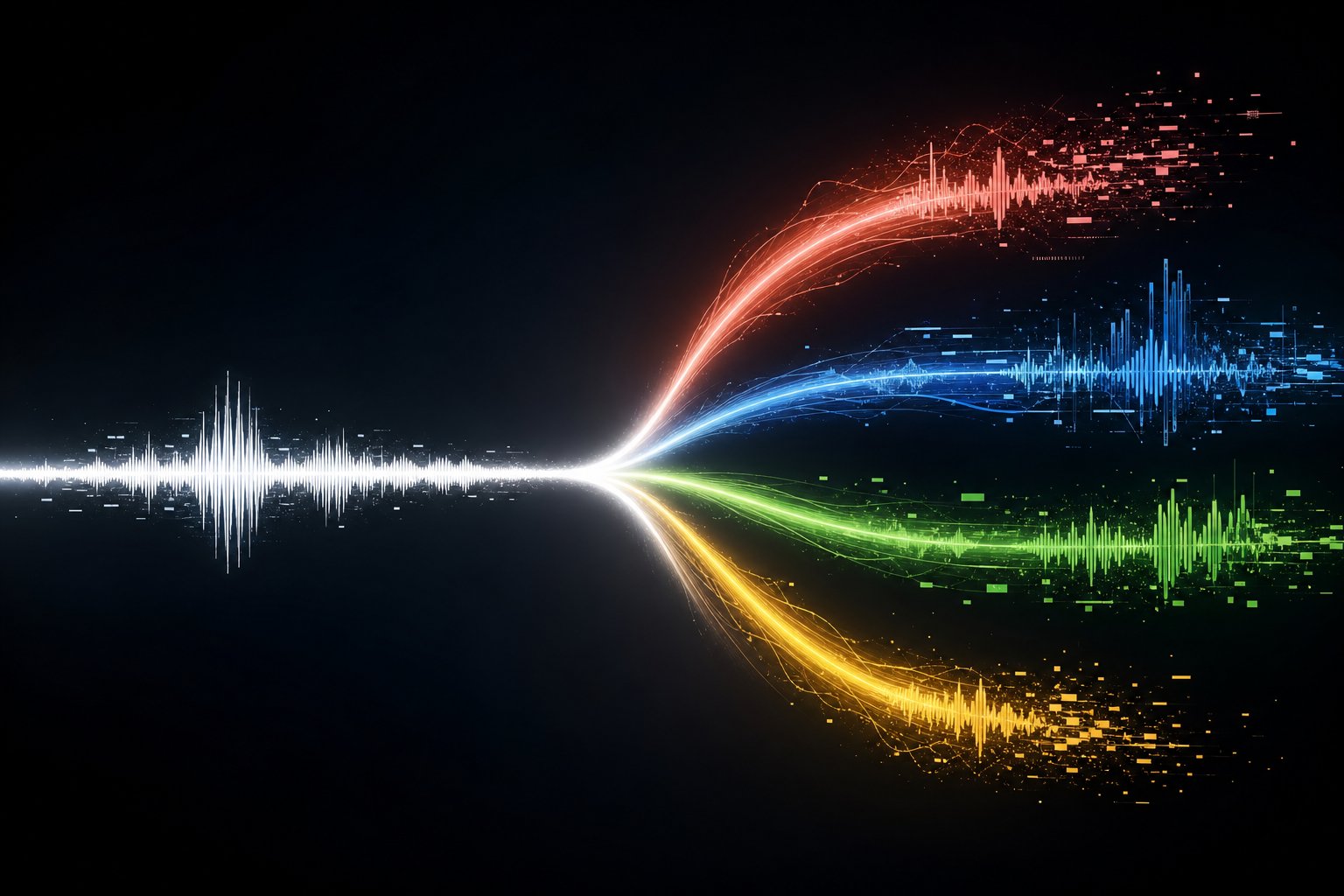
Stem Separation to Reveal Hidden Details in the Full Mix
A flawless audio mix is created to provide a unified and coherent sonic image for the entire piece. This very integrity works in favor of AI. When vocals, drums, bass, and musical instruments play simultaneously, subtle artifacts partially mask each other due to frequency overlap and psychoacoustic masking. Separating each element into an individual stem removes this masking and exposes all flaws to the light. This is why isolating vocal stems has become one of the most effective ways to determine whether a song is AI-generated, especially when automatic detectors yield ambiguous confidence levels.
Why Stem Separation Helps Detect Hidden Artifacts Generated by Artificial Intelligence Systems
Imagine a fully mixed audio track as a crowded room where everyone is speaking at once. You might sense something unusual about one participant's voice, but you won't be able to pinpoint the exact issue until they speak alone. The same principle applies to AI workflows for music analysis. AI-generated tracks often sound convincing in their full version because generators optimize the total output signal. However, they do not optimize individual layers to withstand detailed analysis in isolation.
When you separate a music track into individual tracks—typically vocals, drums, bass, and accompaniment—you begin to notice artifacts that are hidden in the full mix.
- Unnatural vocal formant transitions: In the full mix, a brief formant glitch disappears behind reverb and instruments. In isolation, it sounds as if the voice momentarily belongs to another person.
- Bass lines with physically impossible finger placements: Notes that would require a bassist to teleport along the fretboard become obvious when the bass line plays alone, without drums and guitars masking the transitions.
- Drum hits without micro-variations: Real drummers produce slightly different timbres with each hit due to stick angle, pressure, and head position. AI-generated drums often repeat nearly identical waveforms, and this repetition becomes unmistakably recognizable in isolation.
- Accompaniment layers with synthetic noise profiles: The "other instruments" track often reveals a noise level that bears no resemblance to microphone or preamp noise, instead displaying the statistical fingerprint of a generative model.
Modern AI-based music stem separation technology uses neural networks trained on millions of music tracks to accurately identify and isolate each musical component with high precision. The process involves converting the mixed audio signal into a spectrogram, using pattern recognition to classify frequency ranges by instrument type, and then reconstructing a separate audio file for each isolated track. This AI-driven approach delivers isolation quality comparable to what can be achieved using the original multitrack session.
What to Listen for When Analyzing Isolated Vocal and Instrumental Tracks
Once you have individual music tracks, focused listening becomes much more effective than listening to the entire mix. Below are key aspects to pay attention to when analyzing each track to determine if a song is AI-generated.
- Vocals: Pay attention to overly rapid formant frequency shifts between syllables, vibrato that is reproduced identically on every sustained note, and consonants (especially "L" and "R") that lack the tongue position variation characteristic of natural speech. Breaths, if present, often have an identical spectral profile regardless of where they occur in the phrase.
- Drums: Use the drum stem and focus on hi-hat patterns. Real hi-hat performances feature constant timbral variability—from open-to-closed transitions to changes in stick angle and strike dynamics. AI-generated hi-hats often cyclically replay a small set of nearly identical samples. Ghost notes on the snare, if present at all, are typically perfectly quantized—with no slight forward or backward shift relative to the beat.
- Bass: Watch for artifacts in sliding transitions between notes. Live bassists produce audible string noise when changing positions on the fretboard. In contrast, AI-generated bass lines often jump abruptly from one note to another without smooth transitions or add synthetic slide sounds that do not correspond to real playing techniques.
- Accompaniment: This universal musical element often reveals the core of the production. Guitar chords with equal finger pressure across all six strings, piano chords where every note sounds and decays strictly simultaneously, or synthesizer pads with filters whose sweeps follow mathematical precision—all these point more toward computer generation than live performance.
An audio device detector or spectral analyzer can visualize these issues, but honestly, trained listening skills allow you to detect most of them without visual aids—once you know what to listen for. The isolation itself does the heavy lifting: it removes the masking that makes listening to the full mix unreliable.
Practical Workflow for Rail Inspection
Whether you are a curator screening incoming submissions, an educator introducing students to AI detection methods, or simply a curious listener checking a music track for AI generation, this step-by-step workflow turns stem separation into a systematic detection method.
- Upload the suspicious track to a stem separation tool. Songai's Audio Separator is specifically designed for this purpose. Upload the file, and the tool will split it into individual tracks without requiring any specialized DAW knowledge or technical setup.
- Listen to the vocal track first. Vocals contain the highest concentration of AI artifacts because reproducing the human voice is the most challenging task for generators. Focus on sustained notes, consonant transitions, and breathing patterns.
- Move on to the drum track. Check for micro-rhythmic variations and timbral diversity in repeated hits. Loop a four-bar segment and listen to see if each snare or hi-hat hit truly sounds different or suspiciously identical.
- Examine the bass separately. Listen to the bass track and pay attention to note transitions. Are there realistic string sounds, fret buzz, or slide artifacts? Or do the notes appear and disappear cleanly, without any physical signs of performance?
- Scan the accompaniment track for interaction artifacts. In real recordings, instruments bleed into one another and interact acoustically. AI-generated accompaniment layers often sound hermetically sealed, as if each instrument was created in a vacuum.
- Compare your findings. A single anomaly in one track is not definitive proof. But when vocals exhibit formant jumps, drums lack variation, and the bass has impossible transitions, the cumulative evidence becomes compelling. Use an AI-based music verification tool to confirm what your ears have detected.
This workflow works as the reverse process of AI-powered sample searching. Instead of looking for known samples within a track, you are looking for the absence of human performance characteristics in individual layers. This approach works regardless of genre, tempo, or production style, as it targets the fundamental differences between generated and performed audio.
Songai's Audio Separator makes this accessible to everyone, not just sound engineers with expensive DAW systems. Upload, separate, listen. The entire process takes minutes and provides you with direct evidence rather than an ambiguous confidence percentage. For curators processing dozens of submissions, this provides the "why" behind a detection verdict, which no automated score can offer.
Stem separation is a powerful tool, but it is not foolproof. As AI generators improve and detection methods become more accurate, the arms race between creation and identification continues to accelerate. Understanding where existing detection approaches succeed and where they fail is crucial for anyone relying on these methods in the long term.
Why Detection Is Becoming Increasingly Difficult and What Still Works
All detection methods described so far have a certain shelf life. This is not a flaw in the approach itself—rather, it is an inherent characteristic of the problem statement. AI-based music generators improve with every new update, and artifacts that made detection easy just six months ago may disappear after the next model update. Researchers from the KTH Royal Institute of Technology characterize this dynamic as an "arms race", in which detection systems are forced to constantly adapt in order to identify the outputs of updated generators. Understanding the areas where existing methods fall short is just as important as knowing their strengths.
Why Detection Methods Have an Expiration Date
Consider the evolution of Suno from version v3 to v5. Early versions produced obvious metallic artifacts in the sound and sharp spectral phasing—signs that any trained ear could easily notice. By version v5, these characteristic features had virtually disappeared. The distinctive trace of 32 kHz upsampling still persists, but there are no architectural reasons why it must remain. If Suno switches to generating signals in the native 44.1 kHz format, one of the most reliable spectral indicators will vanish instantly.
This pattern repeats across the board. Detection systems trained on modern AI outputs recognize features characteristic exclusively of current-generation pipelines, rather than universal markers of synthetic origin. Studies in which detectors are tested on platforms not included in the training set clearly demonstrate this problem: classifiers trained on data from Suno and Udio identified only 9–18% of tracks from Boomy as AI-generated, despite Boomy itself being an AI-based platform. Even the commercial detector IRCAM Amplify was able to recognize only 36% of Boomy tracks before it was specifically retuned based on this platform's outputs.
The core issue is that AI-based music detectors do not detect so-called "AI artificiality" in any abstract sense. Instead, they recognize specific processing artifacts arising at certain stages of operation of specific music generation systems at particular points in time. As soon as these systems change, the recognition system stops working. This is Collingridge's dilemma applied to music: methods that are effective in controlled conditions experience serious difficulties adapting when the underlying technology beneath them changes.
False positives and when human music begins to resemble AI-generated music
The flip side of AI missing tracks is the erroneous labeling of human music as synthetic. This problem is not hypothetical. A Cyanite survey showed that more than 70% of artists fear being mistakenly labeled as AI-created, and this fear has a practical basis. Several categories of human-created music regularly trigger false positives:
- Heavily processed electronic music: genres such as EDM, synthwave, and hyperpop use software synthesizers, precise quantization, and aggressive processing, resulting in spectrograms that are virtually indistinguishable from AI outputs. Temporal patterns, spectral smoothness, and noise floor characteristics that detectors identify as synthetic are deliberate aesthetic choices in these genres.
- AI-processed recordings: a singer-songwriter who records real performances but processes the final mix using AI mastering software may inherit enough processing artifacts to trigger detection thresholds.
- Lo-fi and home recordings: paradoxically, low-budget recordings with limited dynamic range and simple arrangements can resemble the outputs of generators like Boomy, which target precisely this aesthetic.
- Vocal processing and Auto-Tune: heavy pitch correction, vocoder effects, and formant shifting create vocal characteristics that overlap with AI vocal generation artifacts.
The consequences of false positives can be extremely serious. Platforms removing AI-generated content risk accidentally removing legitimate works by human artists. An artist whose work is mistakenly flagged as AI-generated may suffer reputational damage, lose income, and face the burden of proving their human nature—this contradicts the presumption of innocence and appears deeply unjust. Even the detector from IRCAM Amplify, which achieves a recall rate of 95.3% for human-created music, still misclassifies about 4.7% of non-AI-generated tracks as AI-created. When scaled to catalogs containing more than 100 million items, this means millions of potential errors.
Any music track evaluation or recognition system that claims to have no false positives should be viewed with skepticism. As the research team at Cyanite emphasizes, the honest reality is this: a track should be labeled as AI-generated only if there is compelling and consistent evidence supporting this conclusion. Conservative thresholds protect artists, but in exchange, some AI-generated content may go undetected.
Which detection approaches are most robust
Not all detection signals degrade at the same rate. Audio artifacts are the most vulnerable because they depend on specific generation architectures that are updated rapidly. The spectral cutoff at 16 kHz disappears as soon as a platform increases its sampling rate. Periodic spectral ripples caused by transformer attention windows disappear when architectures change. While these artifacts are useful currently, they are not suitable as reliable long-term benchmarks.
In contrast, contextual and behavioral signals have proven to be much more resilient. An artist with no social media presence, no live performances, and 200 tracks published in three weeks will still be viewed with suspicion—regardless of how high the audio quality becomes. Release rhythms, collaboration patterns, and engagement metrics reflect fundamental differences between human creative processes and automated content generation, which no model updates can eliminate.
An AI-based tool for analyzing music tracks that combines spectral analysis with behavioral metadata will outperform solutions based solely on audio data precisely because the behavioral layer retains its effectiveness even as audio artifacts change. The most robust detection systems combine several types of signals:
- Most fragile: Specific audio artifacts (spectral cuts, phase distortions, anomalies in noise floor levels). These artifacts can change with model version updates.
- Moderate durability: Structural and temporal patterns (quantization characteristics, arrangement formulas, dynamic consistency). These parameters change more slowly because adjusting them requires fundamental changes to the system architecture.
- Most durable: Contextual and behavioral signals (posting patterns, proof of social support, collaboration history, metadata anomalies). These indicators reflect the economic and logistical aspects of the AI generation process, not its audio quality.
A layered detection approach, combining audio data analysis, contextual signals, and scanning using specialized tools, remains the most resilient solution—even when individual methods become obsolete. No single technique withstands all generator updates, but their combination maintains effectiveness because different layers fail at different times.
This multi-layered philosophy also explains why the task of detecting AI-generated music will never have a final solution. It is not a problem to be solved once, but a practice to be maintained. Specific signs change, tools are updated, and generators evolve. What remains constant is the methodology: combining multiple independent signals, giving more weight to resilient indicators than to fragile ones, and accepting that confidence exists on a spectrum rather than as a binary verdict.
For anyone trying to understand how to reliably identify AI-generated music over the long term, the practical conclusion is obvious. Do not tie your detection confidence to any single artifact or tool. Develop the habit of checking audio, context, and metadata together. When one layer becomes obsolete, others remain relevant. And keep an eye on generator developments, because the arms race does not stop.
Detection limitations raise a deeper question beyond technique. If identifying AI-generated music is so complex and inconsistent, why is it important enough to keep trying? The answer lies in the economic, legal, and cultural aspects that make transparency worth fighting for.

The broader context of why AI-based music recognition systems matter
The ability to determine whether a song is the result of AI generation is not just a fun trick for audiophiles. This skill directly concerns issues of revenue distribution, content ownership rights, and whether human creativity will retain its value in a market increasingly saturated with synthetic content. It involves financial, legal, and cultural consequences affecting everyone from independent songwriters to the listeners who support them.
Royalties, copyright, and who exactly gets paid
Streaming royalties are calculated on a pro-rata basis: the total payout pool is divided by the total number of streams. Each AI-generated track that accumulates streams reduces the per-stream value for human musicians. Forbes reports. Platforms are increasingly integrating AI-generated music to cut costs, further reducing royalty streams for human creators. Why license an expensive catalog if AI can create "good enough" music for free?
Copyright law is rapidly evolving, striving to keep pace with technological advancements. Major music labels have filed lawsuits against platforms Suno and Udio, seeking up to $150,000 per copyright infringement; the agreements already being reached are fundamentally reshaping industry dynamics. In late 2025, Warner Music entered into agreements with both platforms, structuring them not as one-time compensation payments but as long-term licensing partnerships. These arrangements point to the future of the music industry in the context of AI: a system where content generated with artificial intelligence must be based on licensed training data and accompanied by transparent authorship attribution. However, until this system becomes universal, the ability to determine whether a song is an AI-generated result remains the best tool for listeners, enabling them to make informed choices about which compositions to stream and support.
Supporting Human Artists in an AI-Saturated Market
Detection is not access control. It is conscious listening. When you learn to distinguish AI-generated music from tracks created by humans, you gain the ability to direct your attention and streams toward artists who truly perform, write, and record music. This choice has economic significance. Every stream is a micro-vote for the kind of music ecosystem you want.
Platforms are responding to this demand. Does Spotify allow AI-generated music? Yes, but with restrictions. Spotify's updated policy uses the Spotify AI Ddex standard to label AI-generated tracks in credits, prohibits unauthorized voice clones, and launches a spam filter targeting mass-produced content. Bandcamp has gone further, explicitly banning music created entirely or predominantly by artificial intelligence. Deezer labels AI-generated tracks and completely excludes them from algorithmic recommendations. The stance against AI-generated music varies by platform, but the trend toward mandatory disclosure is evident across the industry.
The Future of Transparency and Labeling
Currently, Apple Music requires metadata confirming AI involvement in content creation. YouTube does not allow monetization of audio recordings created with minimal human intervention using AI. The EU AI Act will come into force in August 2026, turning previously voluntary measures into mandatory regulatory requirements. These changes point to a future where transparency becomes not just a recommendation but an integral part of the system—embedded in the very structure of metadata and content distribution channels.
Here is what you can do right now:
- Use a multi-layered detection system: combine audio listening, contextual verification, and scanning with specialized tools, rather than relying on any single method.
- Before recognizing an artist as authentic, be sure to review their profile: look for confirmation of their authority, history of live performances, and list of collaborative projects.
- Use stem separation methods to inspect suspicious tracks at the component level—where artifacts are most noticeable.
- Support platforms that have clear AI labeling policies and prioritize artists with verifiable histories of human creativity.
- Keep up with new developments in detection, as generator updates constantly change what to look out for.
The ability to recognize synthetic music will evolve in parallel with the technologies used to create it. Detection tools will become more accurate, labeling standards more established, and legal frameworks clearer. However, the foundation remains unchanged: understanding what you hear empowers you to make more informed choices about what you support, share, and highlight. It is not about rejecting technology. It is about ensuring human creativity retains its place in a world where the boundary between human-made and automatically generated content becomes increasingly blurred each month.