
Is Artificial Intelligence Completely Taking Control of the Music Industry
Is artificial intelligence taking over the music industry? The honest answer is neither a simple "yes" nor a reassuring "no." AI has already helped create hits for the Billboard charts, gone viral through vocal deepfakes, and secured record label deals, yet it has not displaced human creativity. In fact, the situation is more complex: artificial intelligence is occupying an increasingly significant role in the processes of creating, distributing, and consuming music, forcing all segments of the industry to adapt to changes in real time.
View this less as a hostile takeover and more as a tectonic shift. The ground is shifting beneath the feet of all participants: artists, labels, streaming platforms, and listeners. To understand the real state of affairs, it is necessary to see the full picture, combining the technologies themselves, economic upheavals, legal battles, and how all this actually affects practicing musicians.
What Headlines Miss About AI-Based Music
Most news about AI-generated music presents the topic as a binary discourse: either artificial intelligence will destroy music, or it will be just a harmless amusement. Neither approach reflects the essence of the problem. In reality, the story of generative AI in music in 2025 is one of rapid but uneven transformations. Some professional roles in the industry face a real threat to their existence. Others use AI as a powerful catalyst for creativity. And millions of music fans who had never recorded a single song before are now filling streaming platforms with compositions created using AI.
The question "will artificial intelligence take over the music industry" implies a single possible outcome. In practice, AI is transforming various segments of the music ecosystem at different speeds. A session composer faces a completely different threat than a live-performing vocalist. A home producer today can use tools that did not exist just two years ago. However, headlines rarely account for such detail.
Key Milestones That Changed the Nature of Discussions
Several real events turned AI-based music from a scientific novelty into a subject of comprehensive discussion across the entire industry. Here is how quickly the nature of these discussions changed:
- Viral success of a track with Drake and The Weeknd's voices: in 2023, a TikTok user named Ghostwriter977 released the song "Heart on My Sleeve," created using AI trained on Drake and The Weeknd's music. The track garnered over 9 million streams before Universal Music Group succeeded in having it removed from platforms, sparking a global debate about voice cloning and copyright.
- Breaking Rust's breakthrough and number one on the Billboard chart: the song "Walk My Walk" by an AI-generated country artist topped the Billboard "Country Digital Song Sales" chart. The track accumulated over 3.5 million streams on Spotify, proving that AI-generated music projects can be commercially successful.
- Signing contracts with AI artists: Hallwood Media signed a deal with imoliver — a "music designer" (human) who creates songs using the Suno service; this became the first instance of a label officially signing a contract with a creator of AI-generated music. Additionally, producer Timbaland partnered with Suno to launch a label focused on AI-generated music.
- Xania Monet's mainstream success: an AI-generated R&B artist entered the Billboard "Adult R&B Airplay" chart and attracted nationwide media attention; later, her creator revealed her identity to emphasize the sincere emotions embedded in the song lyrics.
Each of these stages answered the same question in its own way: is AI capable of creating music that surpasses human creations, or at least music that listeners genuinely enjoy? Streaming statistics indicate that listeners do not always distinguish (or simply do not care) whether a track was created by a human or via a prompt. It is this indifference that makes news about AI-generated music so significant for professional musicians in 2025.
These achievements did not emerge out of thin air. Behind every hit that charted thanks to AI lies a complex technological infrastructure—an aspect that is completely overlooked in most publications.
How AI Music Generation Actually Works
You’ve likely read headlines about AI-powered tracks going viral and hitting the Billboard charts. But how does artificial intelligence actually create a song from scratch? In reality, this technology is not as mysterious as it may seem at first glance—especially if you break it down into its basic components.
How Artificial Intelligence Learns to Compose Music
Imagine a composer having access to millions of songs across all genres, eras, and moods. Over time, they internalize certain musical patterns: which chords follow one another, how a verse transitions into a chorus, and what makes a jazz harmonic progression distinct from a pop hook. AI music models operate on the same principle—only instead of intuition, they use mathematics.
The training process begins with processing large audio datasets. These may contain raw audio signals, isolated musical components—such as drums or vocals—as well as metadata describing the genre, tempo, and mood of the composition. Artificial intelligence converts this audio data into numerical representations and feeds them into subsequent processing stages deep neural networkswhich are capable of identifying recurring elements: chord progressions, rhythmic motifs, song structures, and recording and sound processing techniques specific to certain musical genres.
It is crucial to note that the model does not memorize musical pieces by heart. Instead, it learns to identify statistical patterns between musical elements. When you ask it to create something new, the model generates an original piece based on these learned patterns, rather than by stitching together copied fragments.
Generative AI predicts musical sequences just as text AI predicts the next word in a sentence. Instead of assuming that the phrase “the cat sat on the ...” ends with the word “mat,” a music model determines the most likely next step—a specific chord progression, rhythm, or melodic phrase—based on the entire preceding context.
Currently, most AI-based music generation tools operate on two main architectures. Transformer models, similar to the GPT systems underlying text AIs, sequentially predict audio tokens. Platforms like Suno and Udio use their own transformer-based systems capable of generating melody, harmony, rhythm, and vocals in a single pass. Diffusion models, which are closer to the working principle of image generators like Stable Diffusion: starting from a noise signal, they gradually refine it into expressive audio. Both approaches are capable of creating music tracks that listeners struggle to distinguish from human-composed music in blind tests.
Speech synthesis adds another layer of complexity. Today, artificial intelligence is capable of modeling voice timbre, melodic expressiveness, and emotional coloring of performance, creating vocal parts that sound completely natural and convincing. It is this technology that underlies viral deepfake versions of songs and AI performers achieving success on streaming platform charts.
Differences Between AI-Assisted Tools and Fully Generative Tools
Not all artificial intelligence systems in music production function the same way, and this distinction is hugely significant for understanding the direction in which the industry is evolving.
AI-assisted tools keep humans as the primary authors of the process. You can use artificial intelligence to suggest harmonic progressions, generate drum loops as a starting point, fine-tune a finished mix, or separate individual musical layers (stem tracks) from a recording. All creative decisions remain with the performer. A prime example: The Beatles’ song “Now and Then” used an AI-based audio restoration system to isolate John Lennon’s vocals from old demo recordings. This technology was directed toward fulfilling human needs.
Fully generative tools Create entire musical tracks based on a text prompt or minimal input. Enter a phrase like “energetic indie rock with female vocals about a road trip” — and get a finished song: with full structure, melody, instrumentation, vocals, and everything else. No musical education is required. It is this category that raises particularly sharp questions about authorship, originality, and whether AI's ability to assist in music creation will improve to the point where traditional musical skills become optional.
The realm of music and artificial intelligence also includes a third hybrid category. Tools like AIVA combine generative capabilities with professional features — such as MIDI export and stem separation — allowing producers to use AI-generated results as source material for further editing in a traditional DAW.
Understanding this spectrum is crucial because the economic and legal implications can vary drastically depending on which category a particular tool falls into. An AI-based mastering plugin that enhances the sound of your musical composition contributes to increased productivity. However, a system capable of generating thousands of finished tracks daily and uploading them to Spotify represents a completely different phenomenon.

Economic Impact on Musicians and Record Labels
The distinction between AI-assisted tools and fully generative systems is not just a technical detail. It directly reflects the economic fault lines currently dividing the music industry. When one person can create thousands of finished tracks a day without touching a musical instrument, the financial calculations for everyone involved — from home producers to top executives at major labels — change radically.
How AI-Generated Music Is Flooding Streaming Platforms
Imagine you are an independent musician living off modest royalties from online streaming listens. Your fans still listen to you, and the number of plays isn't dropping. However, your monthly income continues to shrink. Why is this happening?
The answer lies in how streaming royalties actually work. Under the pro-rata payment model used by Spotify, Apple Music, and most other major platforms, all subscription and advertising revenue is pooled into a monthly total fund. Your share depends directly on the percentage of your tracks' plays out of the total number of plays on the platform. When more than 50,000 fully AI-generated tracks are uploaded to streaming platforms every day, the denominator grows, while your share remains unchanged — or, even worse, shrinks.
On the Deezer platform alone, AI-generated content now accounts for about 44% of all daily uploads — nearly half of all machine-generated content arriving on the platform. Most of these tracks do not compete with your music for the same listeners: they accumulate low-engagement listens, often generated by bots, which draw from the common royalty pool without creating new revenue.
At present, the only positive aspect is that AI-generated music accounts for less than 3% of actual listening time on platforms like Deezer. However, even 3% of a billion-dollar royalty fund still means tens of millions of dollars being redirected away from musical artists. One high-profile case clearly demonstrated this problem: one individual created hundreds of thousands of AI-based songs and used bot networks to stream them billions of times More than $8 million was collected in fraudulent royalty payments before they were detected. According to Apple Music, approximately 2 billion fake streams were removed in 2025 alone, preventing losses of around $17 million for fraudsters. Spotify removed more than 75 million spam tracks over a single 12-month period.
These figures are simply staggering, and yet they reflect only the volume of content that the respective platforms were actually able to catch.
The New Economy of Musical Creativity
The impact of artificial intelligence on the music industry goes far beyond reducing royalty payments. In essence, it radically changes the cost structure of music production. Tasks that previously required expensive studios, qualified engineers, and weeks of recording time can now be completed in minutes—at a cost that is only a small fraction of previous expenses.
| Category | Traditional Music Creation | Creation with AI Assistance |
|---|---|---|
| Production Time | From several weeks to several months per track | Playback time for one track: from minutes to hours |
| Design Studio Service Costs | $200–$500 USD or more per hour for professional studios. | Monthly subscription from $10 to $50 USD |
| Distribution Barriers | Requires a licensing agreement or official distributor; regulatory bodies are present at every stage. | Direct upload access via aggregators with minimal moderator intervention |
| Skill Requirements | Years of experience in instrumental mastery, knowledge in music production, and professional sound engineering skills | Simple text interface—no musical training required. |
| Collaboration Needs | Group musicians, vocalists, sound engineers, and producers | One person with a laptop |
This sharp reduction in costs has led to the formation of what analysts at Artefact call the "amateur creativity economy." Today, millions of people who are not professional musicians create and release musical compositions. Platforms like Boomy allow entirely new types of creators to instantly create songs, publish them, and even earn revenue in the form of royalties. Years of training or access to expensive equipment are no longer required for musical self-expression.
The rapid growth of this trend is also reflected in the market for music technologies using artificial intelligence. Industry analysts forecast that the volume of this sector will reach $38.7 billion by 2033, up from $3.9 billion in 2023. This tenfold growth indicates the widespread adoption of AI solutions at all stages: from creation and distribution to music consumption. Notably, musicians themselves are more interested in AI-based tools for creating and mastering music (66%) than in technologies for full AI-generated music (47%); this suggests that professionals still perceive AI as a means to expand creative capabilities rather than as a replacement for humans.
What This Means for Artist Revenue
For independent musicians whose music is generated with the help of AI and who earn $500 per month from streaming, even a 5% decrease in income due to AI-generated content means a loss of $25 per month—that is, $300 per year. For those who truly create music, this is a significant financial loss. Major record labels can absorb minor fluctuations in royalties thanks to their legal teams and direct relationships with music platforms. Independent musicians do not have such a "cushion."
Record labels are responding not with resistance, but by restructuring their strategy. Some are fully embracing legislation in the field of artificial intelligence. The emergence of the concept of AI-based record labels—where companies sign contracts with characters created by AI or with human "music designers" who create music exclusively using generative tools—demonstrates a strategic decision to trust that AI-generated content can be effectively commercialized alongside traditional artists. Deloitte's analysis notes that artificial intelligence has already begun to radically change the criteria for selecting artists for collaboration, methods for monetizing music catalogs, and mechanisms by which fans discover music. Today, the question for record labels is not whether to adopt AI, but whether they are moving fast enough to reap the benefits before competitors do.
Meanwhile, music labels leveraging AI are actively working to optimize their music catalogs: using artificial intelligence, they identify songs whose monetization potential has not yet been fully realized, select tracks for synchronization with video and advertising content, and predict which musical elements will resonate with specific demographic groups. A song recorded decades ago can find a new audience thanks to AI-powered discovery algorithms, turning static archives into dynamic commercial assets.
A study by Luminate highlights one encouraging fact: overall, consumers have a negative attitude toward AI-generated content—there are more people who find it confusing or off-putting than those who view it positively. This influx of content is not driven by listener demand; it is almost entirely fueled by individuals attempting to manipulate the system to earn royalties from AI-generated music, rather than by genuine audience interest in such tracks.
However, the economic impacts affect participants in the music industry unevenly. The risks for professionals in different roles within this sector vary significantly depending on how easily AI can replicate the results of their work.
Which positions in the music industry face the greatest threat
A session vocalist recording background harmonies for $200 per track faces a completely different reality compared to a touring artist whose concerts regularly break attendance records in arenas. Artificial intelligence does not threaten the music industry as a whole—it exerts pressure on specific professional roles based on one key factor: the extent to which the work relies on repetitive, templated tasks versus requiring irreplaceable human involvement and creative judgment.
Areas most vulnerable to the consequences of artificial intelligence adoption
Can artificial intelligence completely replace musicians? Available data suggests this is unlikely, but AI will still change the range of skills demanded in the labor market. Below is a comparison of current AI capabilities with specific professional roles, sorted by their degree of susceptibility to technological influence—from most vulnerable to least vulnerable.
- Lead vocalists and background singers: Modern AI-based speech synthesis systems can now reproduce voice timbre, intonational expressiveness, and emotional tone with remarkable accuracy. Analysis of voice cloning technologies, conducted by Reprtoir It should be noted that the widespread adoption of this technology may directly reduce demand for session vocalists, limiting their professional opportunities and income sources. Previously, a producer might hire a singer for $300 to record choral parts, whereas now they can create convincing vocal tracks in just a few seconds. This is why artificial intelligence negatively affects artists whose careers are built on performing functional vocal tasks rather than on their star power.
- Contemporary and library music composers: Composers creating background music for commercials, podcasts, YouTube videos, and corporate content are under significant pressure. Thanks to artificial intelligence, instrumental tracks matching a specific mood can be generated instantly, and clients who previously paid $500 for a custom synchronized composition can now obtain perfectly usable material for free. The functional nature of this work makes it highly susceptible to automation.
- Mixing and mastering engineers: AI-based mastering tools have been available on the market for over a decade. A study by LANDR found that 79% of sound engineers already use artificial intelligence to perform technical tasks—such as mixing, mastering, or audio restoration. Modern tools have advanced so much that their results for standard projects are virtually indistinguishable from the quality of work produced by a professional mastering engineer. Engineers specializing in complex, high-budget sessions continue to command high fees, but the mid-tier market is shrinking rapidly.
- Beat makers and loop creators: Artificial intelligence can generate rhythmic patterns, chord progressions, and instrumental loops—all of which can serve as foundational elements for music production. Beat producers selling their works on music platforms are facing increasingly fierce competition from free alternatives created with AI.
- Performers and singer-songwriters: Live performances, personal branding, and emotional authenticity remain areas that AI struggles to replicate. Musicians touring across the country—including those whose songs are generated by AI—are still in the most advantageous position, because audiences pay not only for the sound but also for the performer's personal presence.
The pattern is clear: the more a role depends on delivering functional results without ties to a personal brand, the more vulnerable it becomes. AI musicians and singers created with AI can replace specialists in cases where being "good enough" suffices. However, they fail where the audience demands an authentic human story.
Where Artificial Intelligence Augments Rather Than Replaces Humans
The same technology that threatens certain professions is simultaneously actively empowering others. Famous musicians using AI do not hide it—they integrate the technology as a tool for creative acceleration.
Producers are the most prominent example. According to the same LANDR research paper, 66% of producers use artificial intelligence creatively—for writing lyrics, creating melodies, selecting instruments, or vocal parts. However, only 13% of them use AI tools to create an entire song. Most of them use AI to generate individual elements—such as a drum loop or vocal harmony—with the aim of complementing existing arrangements. Artificial intelligence helps bridge skill gaps without replacing the producer's creative vision.
Composers use generative tools for rapid prototyping—in just a few minutes, they can create ten variations of the same theme instead of spending hours on it. The results of AI work are not the final product: they are raw material that a skilled human turns into a work with a clear concept and subtle nuances. Songwriters use AI to overcome creative block and generate melodic ideas they would never have stumbled upon on their own.
Even vocalists find certain advantages in this. Voice cloning technology allows artists to create content in multiple languages, restore damaged recordings, or record demos without the need to book studio time. The key difference is that they use artificial intelligence with their own voice, while maintaining full consent and creative control over the process.
Can artificial intelligence replace musicians? A more honest formulation would be: AI will replace individual tasks for which musicians are currently paid, while simultaneously creating new workflows that encourage adaptability. 65% of producers who state they are willing to use AI-based generators at some stage of their work are not abandoning their craft—they are transforming it. The roles that will survive and thrive are those where technical qualification is combined with what artificial intelligence is not yet able to reproduce: aesthetic taste, narrative skill, and creative risks possible only thanks to personal life experience.
However, the question of who has the right to make such decisions is not limited to studios and streaming platform interfaces—it is also being decided in courts, where lawsuits and new legislative initiatives define the legal frameworks that will ultimately shape the future of music created with the help of artificial intelligence.
Legal Disputes That Will Decide the Fate of AI-Based Music
Today, courtrooms have become the frontline of the battle. While music producers experiment with artificial intelligence tools and labels sign contracts with AI-created performers, a parallel struggle is unfolding in federal courts and legislative bodies—this is what will determine the actual rules of interaction in this field. Never before has the topic of AI in the music industry developed at such speed, and the outcome of these lawsuits will decide whether AI-generated music will function as a licensable industry or remain an unregulated, chaotic environment without any rules.
Major Lawsuits Shaping the Legal Framework in the Field of AI-Based Music
In June 2024, the three largest music companies—Sony Music, Universal Music Group, and Warner Music Group—sued AI-based music generation services Suno and Udio, accusing them of so-called "mass infringement" of copyright. The main accusation is that both platforms trained their generative models on copyrighted sound recordings without proper permission and subsequently used these models to create music competing with original works.
Since then, these cases have developed according to different and fundamentally distinct scenarios. UMG reached an agreement with Udio in October 2025, and Warner did so in November of the same year; both parties concluded licensing agreements for the use of the new AI-based music platform. Sony Music, on the contrary, continues to actively pursue its case. Having gained access to Udio's training data during procedural investigations, the company added more than 30,000 copyrighted recordings to its lawsuit. In a similar lawsuit against Suno, UMG and Sony publishers attempted to include more than 61,000 musical recordings as evidence after it became known that Suno had used "millions" of their copyrighted tracks to train its algorithms.
One important admission changed the legal landscape: in court documents, Udio confirmed that it “received audio data from YouTube for use as training samples” using YT-DLP—a tool for capturing streaming audio. This served as the basis for adding a claim of circumvention of technological protection measures (under the Digital Millennium Copyright Act—DMCA) to the initial copyright infringement claims. Judge Alvin K. Hellerstein denied Udio’s motion to dismiss this count, finding that the plaintiffs had presented plausible arguments that YouTube employed access control measures that were circumvented by Udio.
Suno and Udio argue that their use of musical materials constitutes “fair use” under U.S. copyright law. Udio describes its approach as a “typical example of fair use” and accuses Sony of “anti-competitive actions aimed at strengthening an illegal monopolistic position in music production and commercialization.” The question of whether such use is permissible remains unresolved, and its resolution will determine whether AI companies need licenses or can freely train models on existing musical works.
Here is the current status of key lawsuits:
- Sony Music v. Udio (Southern District of New York): Active. Sony intends to register another 30,442 copyrighted works after identifying them. The DMCA violation claim was retained following a motion to dismiss. The defendant argues fair use of content; summary judgment on this issue is currently being considered.
- Major Record Labels v. Suno (District of Massachusetts): Active litigation: UMG and Sony plan to add more than 61,000 sound recordings. It was found that Suno’s system was trained on millions of copyrighted tracks.
- UMG/Warner and Udio Agreements: Resolved through licensing agreements. Udio’s licensed platform, “Starstruck,” is scheduled to launch in 2026.
- Blanco Brown Style Imitation Claim: This lawsuit tests precedents and explores whether AI-generated music that imitates a specific artist’s style without copying actual sound recordings constitutes copyright infringement. The case goes beyond existing sampling laws and touches on previously unexplored aspects of artistic identity.
Will artists using Suno have to pay if record labels win the litigation? This depends on how courts assign liability. If fair use arguments are not upheld, the platforms themselves may bear legal costs, but individual authors using these services could face consequences—depending on how licensing systems are structured.
New Legislation to Protect Artists
Lawmakers are not waiting for the courts to resolve this issue. Tennessee took the first initiative: in early 2024, Governor Bill Lee announced his plans. The Ensuring Likeness Voice and Image Security (ELVIS) Act became the first legislation in the country to explicitly include “voice” among protected personal rights. Tennessee’s music industry supports more than 61,617 jobs and contributes $5.8 billion to the state’s GDP, so the economic implications were clear.
The ELVIS Act aims to regulate AI voice-cloning models that could be used to create unauthorized deepfake audio recordings of a person’s voice. As Harvey Mason Jr., CEO of the Recording Academy, noted during the presentation, this bill “will protect Tennessee’s creative community from deepfakes and AI voice cloning and set a benchmark for other states.” The bill received support from more than 20 industry organizations, including ASCAP, BMI, SAG-AFTRA, and the National Music Publishers’ Association.
Beyond Tennessee, the federal policy landscape is also evolving. The U.S. Copyright Office launched an official initiative on artificial intelligence in 2023, which received more than 10,000 public comments. Since then, a series of reports has been published: the first part (July 2024) addressed digital replicas and recommended a federal legislative framework in this area; the second part (January 2025) analyzed copyright issues related to AI-generated outputs; and the third part (May 2025) examined the training process of generative AI systems. These reports play a key role in shaping Congress’s approach to developing potential federal legislation.
In Europe, the EU AI Act introduces transparency obligations for generative AI systems, including the requirement to disclose the use of copyrighted materials in model training. For music, this means that AI companies operating in Europe may be required to provide detailed information about the data used for training, ensuring rights holders with the transparency they currently lack in US litigation.
The Unresolved Issue of Copyright in Artificial Intelligence
At the heart of every lawsuit, every bill, and every news story about AI-generated music in the realm of copyright lies a set of questions to which no court has yet provided a definitive answer.
If an artificial intelligence model analyzes millions of copyrighted musical compositions and creates a new work on this basis that does not copy any existing sound recordings, can this be considered copyright infringement, and who, if anyone, is the rights holder of the resulting output?
The US Copyright Office has published partial guidance. According to its registration policy, works created solely by artificial intelligence without significant human creative input cannot be protected by copyright. The decision in Thaler v. Perlmutter confirmed that works entirely created by artificial intelligence lack the human authorship necessary for copyright recognition. But what if a song is written by a human—he wrote the lyrics, chose the style, and selected the best option from dozens of AI-generated variants? This gray area still lacks a clear legal definition.
The current situation regarding rights to music created using artificial intelligence reveals three key legal questions that remain open. The first is the issue of model training: is the use of copyrighted musical works to train AI a violation of copyright, or is it an example of transformative fair use? The second is the issue of generation output: where is the line drawn if AI creates a work that sounds similar to copyrighted material but is not a direct copy? Thirdly, the issue of ownership: if a person uses artificial intelligence as a tool to create music, who is the rights holder—the person themselves, the company that developed the AI, or neither?
This is not just a theoretical discussion. The outcome will determine whether AI-based music content platforms will be required to pay billions in compensation or can continue operating in a free environment, whether tracks created using AI can be registered and monetized like traditional sound recordings, and whether artists have legal avenues for protection in case of unauthorized copying of their voice or style. Answers are likely to come gradually—through settlement terms, court decisions, and legislative initiatives over the next few years.
While courts define these boundaries, streaming platforms continue to develop actively: they are developing their own policies, detection systems, and content rules to manage the flow of AI-generated music that is already reaching their servers.
How Streaming Platforms and Live Music Shows Are Adapting to New Conditions
Courts and legislators are defining the legal framework, but streaming platforms face a more urgent problem: AI-generated music is already stored on their servers, already accumulating listens, and already drawing revenue from royalty pools. They cannot wait for a court decision—they need measures now. As a result, a fragmented picture of response measures has emerged: from complete bans to cautious transparency requirements, each reflecting different expectations about the direction in which the music industry will develop in the context of AI.
How Streaming Platforms Are Responding to the Surge in Artificial Intelligence Use
All major platforms face the same dilemma: the more content, the higher user engagement and the longer they stay on the service. However, an uncontrolled flow of AI-generated content reduces royalty fees for live artists, undermines listener trust, and attracts regulatory attention. Each platform occupies its unique position within this range.
Spotify has removed more than 75 million spam tracks Over a single 12-month period, the company implemented a specialized music spam filter capable of detecting mass content upload schemes and stopping the recommendation of flagged material. The platform also introduced a strict policy against identity impersonation, prohibiting unauthorized AI-cloned voices, and began supporting the industry-standard DDEX for disclosing AI use in music credits. Starting in April 2026, artists can voluntarily indicate AI contributions to specific elements of a composition—such as vocals, lyrics, or sound design.
Apple Music has adopted an approach focused on transparency by implementing metadata that requires labels and distributors to disclose information about the use of AI in creating music or cover art. Instead of banning AI-generated content, Apple provides partners with the right to determine what constitutes "AI-generated content," while ensuring listeners have access to this information.
Some platforms have gone further. Bandcamp has explicitly banned music created entirely or predominantly using AI, reserving the right to remove anything it deems to be fully generated. Deezer has developed its own AI detection tools that flag songs created entirely using AI, exclude them from algorithmic recommendations, and completely exclude fraudulent AI-generated streams from royalty calculations. Qobuz released an "AI Charter," committing to 100% human-curated recommendations and excluding AI-generated content from playlists.
YouTube Music takes a middle-ground position: audio recordings generated exclusively using AI with minimal human intervention are classified as low-priority content and are not eligible for monetization. The policy emphasizes the importance of "transformative human contribution"—meaning tracks created using AI but including genuine performance, commentary, or narration can still generate revenue. However, materials created entirely from text prompts without human involvement are subject to demonetization or removal.
Here is how major platforms compare in terms of news and policies regarding the regulation of artificial intelligence-based music:
| Platform | AI Content Policy | Labeling Requirements | Preferential Treatment |
|---|---|---|---|
| Spotify | Allows the use of AI-assisted music; prohibits unauthorized voice clones; includes a spam filter to block mass uploads. | Supports the DDEX standard; voluntary disclosure of AI in credit data (beta version launching in April 2026). | All music tracks are evaluated on an equal basis of listener engagement; spam recordings are filtered out of the royalty pool. |
| Apple Music | Allows the use of AI-based content with a focus on transparency. | Mandatory metadata that must be provided by producers or distributors when disclosing information about the use of AI. | Standard royalty calculation procedure; approximately 2 billion fake streams were excluded in 2025. |
| YouTube Music | Raw audio data generated by AI is not eligible for monetization; significant human editorial work is required for its use. | Mandatory disclosure of AI use | AI-based content that does not result in the transformation of content licensed under Creative Commons licenses without commercial rights is either demonetized or removed. |
| Bandcamp | Complete ban on music created entirely or significantly using AI. | No access (prohibited content was removed) | Content created using AI is not eligible for sale. |
| Deezer | AI detection tools automatically flag fully generative tracks; such tracks are excluded from recommendations. | On-screen labels for detected AI-generated content | Manipulated AI data streams identified during royalty calculation filtering |
| Qobuz | AI Charter; proprietary content detection tool; excludes industrial AI-based content from playlists | AI-generated content marked in the catalog | 100% expert-curated recommendations; AI-generated content has lower priority. |
| SoundCloud | AI-assisted uploads are allowed; administration commits not to use materials uploaded by authors to train AI systems without their explicit consent. | Mandatory labeling is not required. | Standard royalty payment procedure |
| Tidal | No strict restrictions on uploading tracks using AI; administration commits not to use uploaded materials to train AI systems. | Mandatory labeling is not required. | Standard royalty payment procedure |
The general trend observed in recent updates to music AI systems is clear: platforms are increasingly leaning towards transparency and violation detection systems rather than universal bans. Most understand that creating music using AI is a spectral process, and drawing a clear line between "human" and "AI-created" music is becoming less realistic. Major enforcement efforts are now focused on combating fraud, authorship forgery, and mass content uploads aimed at deceiving royalty payment systems.
Artificial Intelligence in Live Performances and Concert Tours
Streaming is not the only area adapting to new technologies. Live musical performance, long considered resistant to AI adoption due to its reliance on the presence of live performers, is now gradually integrating these technologies in more subtle ways. AI-generated visual effects are actively used in stage productions today—they create dynamic graphic elements that respond in real time to the music's tempo, audience mood, and lighting cues. Sound engineers employ AI-based mixing tools that automatically optimize audio accompaniment for the acoustic characteristics of a specific venue in real time.
Virtual artists represent the most provocative frontier of the modern entertainment industry. Artists created with the help of artificial intelligence can perform in holographic or screen-based formats, eliminating transportation costs and physical limitations. Although audiences still largely prefer live performances by human artists on stage, the cost-effectiveness of tours featuring AI artists—especially in the context of licensing music for virtual performers—is attracting investment from producers exploring hybrid event formats.
The principal advantage of a live music show remains its irreplaceability. Yes, you can stream a song generated with the help of AI, but it is impossible to recreate the shared atmosphere and emotional interaction characteristic of a concert. This is why revenue from concert tours is becoming even more critical for artists whose income from music sales is under pressure due to the mass emergence of AI-generated content on music platforms.
Platforms are actively strengthening their protective measures, and legislative initiatives are already beginning to take shape. However, for creators who are currently trying to adapt to this dynamically changing environment, the more pressing practical question remains: what AI-based music generation tools actually exist, what can they do, and which ones are truly worth spending time on?
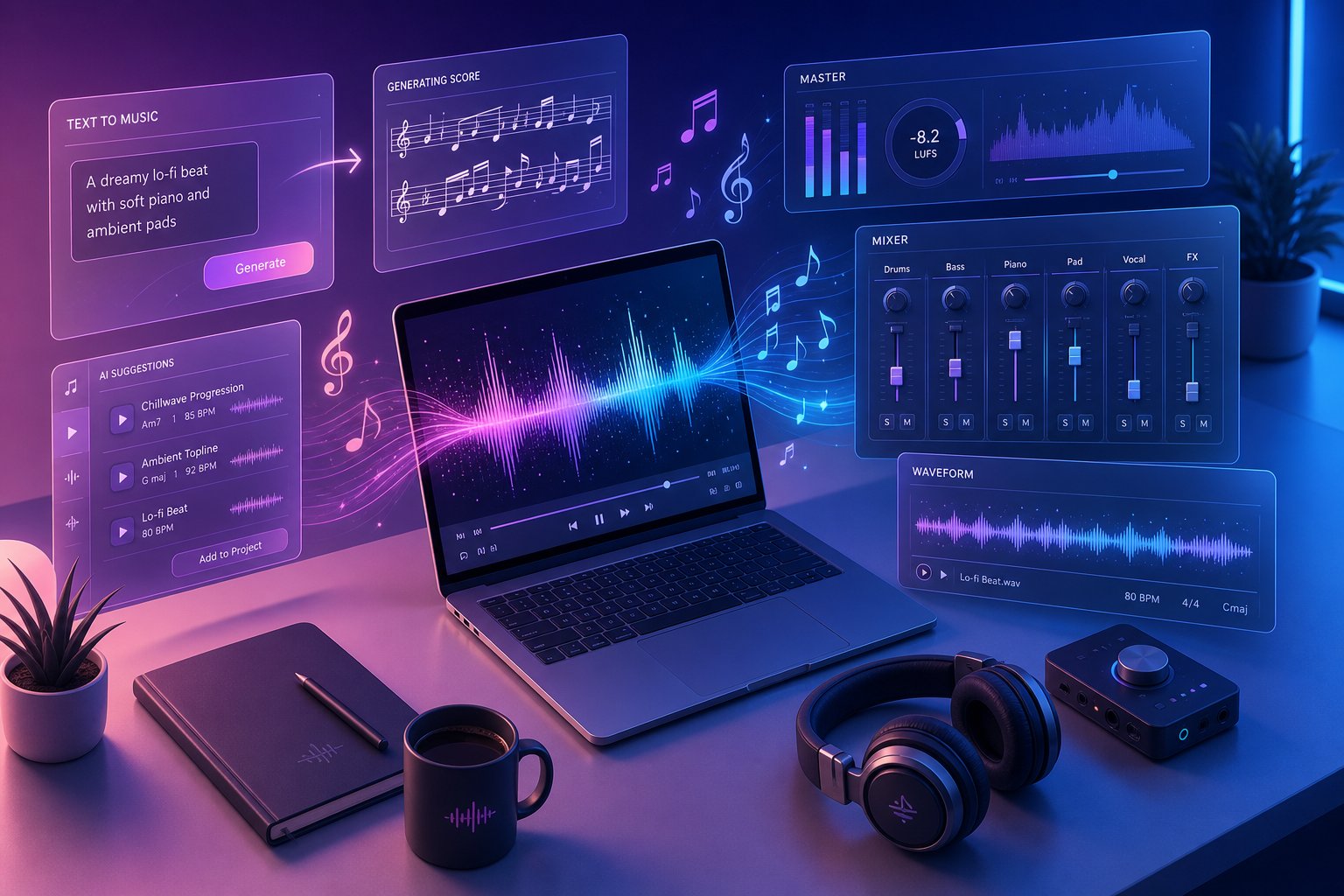
AI-Based Music Generation Platforms and Tools Worth Knowing About
It is one thing to realize that artificial intelligence is radically changing the music industry, and quite another to understand which specific tools actually work in practice. The landscape of companies specializing in AI-based music is rapidly expanding, with each platform occupying its unique niche. Some can create entire compositions based on just a single sentence, while others provide basic tracks and MIDI files for professional refinement. Choosing an unsuitable solution leads to wasted time and money—therefore, below is a comparative overview of leading solutions for those interested in using AI in music production.
Comparison of Leading Artificial Intelligence-Based Music Platforms
Differences between various platforms come down to several key factors: input data, output results, degree of control over the process, and the possibility of commercial use of the resulting product. Below is a comparison of tools defining modern artificial intelligence technologies in music production:
| Platform | Primary Use Case | Input Method | Output Quality | Accessibility |
|---|---|---|---|---|
| Songai | Creating songs based on a prompt with control over lyrics and musical style | Text prompts, lyrics, style descriptions | Full versions of songs with vocals—ready for sharing. | Ideal for beginners—no musical training required. |
| Suno | Full song generation with vocals | Text prompts, custom lyrics, uploaded audio recordings | Professional grade with v4.5 and v5 models; supports audio recordings up to 8 minutes long. | Very simple: the free plan provides 50 credits per day. |
| Udio | Generation and remixing oriented toward producers | Text prompts, lyrics, reference audio recording | High playback accuracy up to 48 kHz; individual stem downloads available. | Moderate learning curve; 10 free credits per day. |
| AIVA | Cinematic and orchestral composition | Preset styles, MIDI/audio references, text prompts | Structured compositions up to 10 minutes long; MIDI export. | More complex interface; intended for composers. |
| Boomy | Content creation for beginners and direct streaming distribution | One-click style selection | Functional tracks—less than 30 seconds | Lowest barrier to entry; built-in support for distribution via Spotify. |
| Soundraw | Background music for video content creators | Selection of key, genre, and instruments (no text prompts) | Instrumental compositions with smooth rhythm and customizable musical fragments | Interface is intuitive even for those who do not play musical instruments; no vocals required. |
Suno remains the standard choice for most users who need to quickly obtain a finished song. Suno v4.5, currently available in the free plan, can create compositions in a wide variety of genres—from indie rock to afrobeat—with convincing vocals and logical song structure. However, there is a compromise: control over individual sound elements is more limited here.
Udio is particularly appealing to producers who want to split music tracks into separate stems. Features such as uploading individual stems, inpainting to correct specific parts of a track, and changing the music genre via AI through the remix function make this platform an optimal choice for those planning to use AI-generated results in a DAW for further processing. After announcing news about Udio AI's music capabilities in December 2025, the platform settled a lawsuit with UMG and announced the launch of a licensed platform called Starstruck — this demonstrates its commitment to legitimacy and should reassure creators concerned about copyright infringement risks in subsequent stages of content usage.
AIVA targets a completely different audience. This platform is most often used by film composers, video game developers, and advertisers who require instrumental musical compositions with clear copyright ownership. The Pro plan provides full ownership of the created works — a key advantage, especially important for commercial licensing.
Boomy and Soundraw occupy extreme positions in terms of functionality. Boomy allows even complete beginners to create and publish tracks on streaming platforms in just a few minutes. Soundraw completely eliminates text prompts, giving video content creators the ability to adjust the mood and intensity of the music using sliders rather than words. Neither service can match the depth of sound offered by tracks from Suno or Udio — but that is not their goal.
Find the perfect tool to achieve your creative goals
Choosing the right platform depends entirely on your goals. A YouTuber who needs background music and a songwriter who views AI as a creative partner for making music have completely different requirements. Here is a brief decision-making algorithm:
If you want to turn a lyric idea or style description into a finished song without using a DAW (Digital Audio Workstation), Songai offers the most direct path from concept to completed track. You describe the desired outcome, insert lyrics (if any), choose a style direction, and receive a fully arranged composition. This is an excellent starting point for those curious about what generative AI can do in music but who do not want to spend time mastering complex interfaces.
If you are a producer who needs "raw" material for further processing, Udio's stem export and inpainting features will provide you with maximum flexibility after generation. If you need orchestral music with reliable commercial rights, AIVA is designed specifically for such tasks. And if you simply want to experiment without any obligations, Suno's generous free tier allows you to generate about ten songs per day completely free of charge.
The main takeaway is this: AI for music creation is not a single tool. It is an entire ecosystem where different platforms serve different creative intents. The best approach is to try several services, evaluate their strengths and limitations based on your own experience, and then decide what role AI will play in your workflow, rather than viewing any one platform as a universal solution.
These tools demonstrate the current state of the AI music field. However, technology is evolving faster than many realize: the journey from a simple novelty to a hit topping the Billboard charts took less than two years. Where this acceleration leads next depends on factors whose scale goes far beyond the capabilities of any single platform.
In which direction will musical AI develop in the future
Two years — that is how long it took for AI-created music to go from a viral novelty on TikTok to a number-one hit on the Billboard chart. The pace of this process is growing not linearly, but exponentially. Each major milestone — whether it was a deepfake track with Drake's voice, signing a contract with an AI artist, or charting — occurred faster than the previous one. If this dynamic continues, the past two years will seem like just a warm-up compared to the events of the next two years.
The acceleration pattern and what it might mean
Pay attention to the timeline of events. In early 2023, the song "Heart on My Sleeve" went viral as a novelty — people shared it precisely because it seemed quirky and impressive. By mid-2025, AI-based artists were already signing contracts with real record labels and appearing on the Billboard charts. By the end of 2025, platforms like Deezer were receiving over 50,000 fully AI-generated tracks per day — accounting for about one-third of all new uploads. The band The Velvet Sundown, created with the help of artificial intelligence, gathered over a million monthly listeners on Spotify before anyone realized it was not a live group.
This pace reveals an important fact: technology has not reached a plateau. Each new generation of models generates increasingly convincing results, is capable of processing longer musical compositions, and requires less and less human intervention. The current news cycle around generative AI for music clearly demonstrates this: what was considered a cutting-edge solution six months ago is now available in the free version of the service. And what seems impossible now will likely become a standard feature by next year.
The stakeholder map has become no less complex. Regulators are developing legislation. AI companies are rushing to build sustainable platforms. Major music labels are simultaneously suing AI companies and entering into partnership agreements with them. Independent artists are caught between fear and experimentation. Amateurs are flooding platforms with content. Streaming services are developing violation detection systems while quietly benefiting from the increased engagement driven by the growing volume of content. Each group is moving in its own direction, and none of the participants can control the final outcome.
Will audiences care who created the music
This is perhaps the most important question in the entire discussion about AI-generated music. Technologies and laws may set boundaries, but it is ultimately listener behavior that determines what survives in the market.
Research results paint an intriguing picture. In an experiment conducted by Friedrichsen, Schwartz, and Clement, it was found that in blind tests, listeners rated AI-generated songs higher than human-composed tracks. However, once they learned that a song was created by artificial intelligence, their desire to listen to it again and their willingness to pay for it noticeably decreased. Another study conducted by Deezer and Ipsos showed that 97% of respondents could not accurately determine whether tracks were created by AI or humans.
It turns out that audiences enjoy AI-generated music—they just don't want to know that it is exactly that. This paradox creates a strange system of incentives. Transparency, which regulators and platforms advocate for, may actually reduce the commercial potential of AI-generated tracks. At the same time, AI-generated content without attribution may succeed precisely because listeners do not notice the difference.
Music curator Antonia Folguera accurately characterized this contradiction in an interview for the Music Technology Group project: she noted that she would not mind if her next favorite song was created by AI, but admitted that she "would quickly get bored" if she knew the author was a computer program. The emotional connection to the human story behind the music remains important—even when the sound of the compositions is indistinguishable.
The most likely future is neither the complete replacement of musical performers by artificial intelligence nor its total rejection by humans. Instead, a hybrid model is expected, where AI takes on routine and templated tasks, while human artistic mastery retains high value due to authenticity, rich narrative components, and live stage presence.
Will artificial intelligence completely take over the music industry? Available data points more toward coexistence than total domination. AI will dominate where music is viewed as a commodity: background tracks, mood playlists, functional sound materials for content creators. Human artists will maintain their influence where music is perceived as culture: albums with storylines, live performances with a sense of presence, voices connected to real lives and genuine emotions. However, the boundary between these two worlds will continue to shift as technologies evolve and audiences adapt.
The future of music will not be determined solely by technology. It will be shaped by the choices musicians, creators, and listeners are making now: choosing tools to work with, defining priority values, and determining their place in the ever-changing musical landscape.
What musicians and creatives should do next
It is more important to understand what to do today than to know where artificial intelligence in the music industry is heading. The situation is changing rapidly, but the right steps depend on who you are and what you want to preserve or build. Below is a specific action plan for each group going through this transition period.
What Independent Artists Should Do Now
If you are a professional musician, the worst thing that can happen is complete paralysis. The artists who will succeed are those who actively leverage what artificial intelligence cannot reproduce, while deeply understanding its capabilities. As stated in Fast Company's analysis: artificial intelligence can write a song, but it cannot build a music career. Your humanity, your unique story, and your live stage presence are competitive advantages that only strengthen over time.
- Double down on authenticity and personal brand development. Be open about your creative journey, share your story, and reveal the human context behind your music. Audiences crave genuine emotional connection—something artificial intelligence cannot provide.
- Prioritize live performances and community engagement. Revenue from concert tours and direct interaction with fans are income sources resilient to AI influence. Create a Discord server, host regular live streams, and personally respond to comments.
- Learn the tools instead of fearing them. Use artificial intelligence for rapid prototyping, creating demos, or filling gaps in production skills. 66% of producers who already creatively apply AI do not abandon their craft—on the contrary, they expand its possibilities.
- Diversify income sources beyond streaming. Synchronization licensing for soundtracks, merchandise sales, limited edition releases, and personalized fan events all hold value that cannot be diminished by the surplus of AI-generated content.
- Stay informed about the latest legal news and legislative changes. Understand your rights regarding voice cloning, style imitation, and consent for training data usage. If a platform offers the option, opt out of having your work used to train artificial intelligence systems.
For music producers, the benefits of artificial intelligence in music are particularly evident when generative tools are viewed not as replacements, but as partners in the creative process. Within seconds, you can generate ten variations of a drum pattern, use AI to create chord progressions that would be difficult to stumble upon alone, and then adapt the result to fit your musical taste and professional judgment.
How to Start Creating Music with Artificial Intelligence
For music enthusiasts and creatively inclined individuals, the only reliable way to understand what music and artificial intelligence can offer together is to try it yourself. Theoretical descriptions of AI-based music remain abstract, but when you create your first composition, the capabilities and limitations of the technology become clearly tangible in practice.
- Create your first song. Go to the AI Music Generator by Songai and turn a simple idea, mood, lyric snippet, or style description into a full-fledged music track. No musical education is required—just one idea and a few minutes of free time.
- Write your own lyrics. Even rough, conversational phrases will make your lyrics sound ten times more thoughtful than standard automatically generated options. In this case, specificity is always more important than smoothness and sophistication.
- Instead of judging the first result, refine and improve it. Generate three to five variants, pay attention to the changes that occur when adjusting the initial prompt, and gradually develop an intuition for guiding generation results according to your vision.
- Write and share what you create. Feedback from real listeners will give you more insight than any ten or twelve personal experiments. Publish your composition and see how people react to it.
For music fans, your role is also significant. Support living artists directly—buy their merchandise, concert tickets, and use platforms that ensure transparent compensation for content creators. Your music choices directly determine which economic model ultimately prevails.
The question of whether artificial intelligence would appear in the music industry was never in doubt—it is already there. Today, what matters more is whether you will define how AI integrates into your creative process, or allow it to shape you by default.